 airbrakecompressor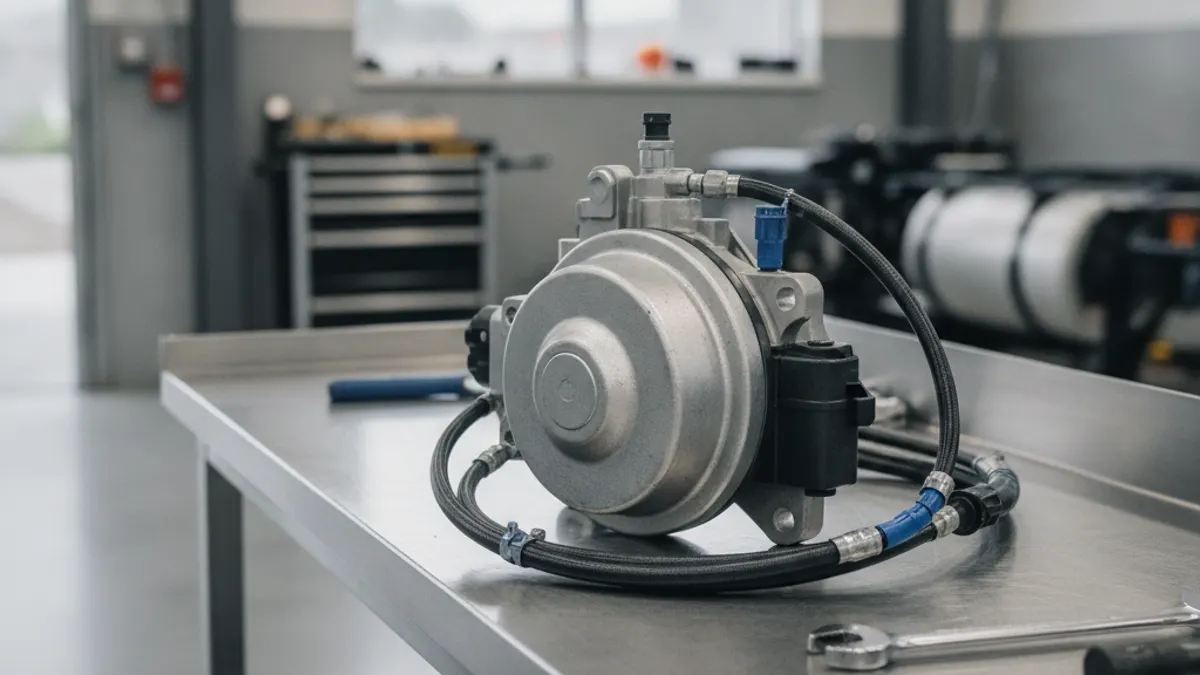
Haldex is a Swedish-founded brake and suspension supplier, now part of the SAF-HOLLAND group, and its air brake range sits on the actuation and control side of the system rather than the charging side. That means automatic brake adjusters, air disc brakes, service and spring brake chambers, trailer EBS/ABS modulators, air dryers, load sensing valves and air suspension control valves — mostly on trailers and on European and North American axle assemblies. Haldex does not build the engine-driven compressor, so a "Haldex air brake system" normally describes the valves, actuators and electronics of the pneumatic circuit. When you replace a part, match it by the number stamped or labelled on the unit and by the trailer or axle build spec: port layouts, thread forms, spline details and EBS calibrations differ between families and generations.
Where Haldex parts sit in the system
Air brakes are pneumatic, not hydraulic. The engine-driven compressor charges the reservoirs, the governor cuts out at roughly 120–135 psi and cuts back in at roughly 100–110 psi, and the driver's foot valve meters that stored air out to the chambers. Haldex hardware works downstream of that supply, in three areas:
- Foundation brake — automatic slack adjusters on S-cam axles, and air disc brake calipers on disc-equipped axles and trailers.
- Actuation and control — service and spring brake chambers, relay and load-sensing valves, trailer EBS modulators and ABS valves.
- Air treatment and suspension — single-cartridge air dryers, levelling valves and lift axle control valves.
In North America, much of what technicians still call "Midland" or "Anchorlok" hardware came into the Haldex range through earlier acquisitions, which is why an older trailer can carry three different castings doing the same job.
Haldex air brake product families
| Family | What it does | Service notes |
|---|---|---|
| Automatic brake adjusters | Maintain S-cam brake running clearance as lining wears | Repeated manual adjustment to chase stroke means the adjuster or foundation brake is faulty |
| Air disc brakes | Caliper-and-rotor foundation brake, self-adjusting | Check guide pin boots and caliper free movement; a seized guide causes uneven pad wear and drag |
| Service and spring brake chambers | Convert air pressure to mechanical push-rod force; the spring section parks the vehicle | The spring section applies as pressure falls, typically in the 20–45 psi range; never cut or disassemble it |
| Trailer EBS | Electronic braking with ABS, roll stability and diagnostics | Replacement units normally need parameters loaded with the correct diagnostic tool |
| Load sensing and levelling valves | Match brake pressure or ride height to axle load | Linkage geometry matters; a bent or missing rod ruins braking balance |
| Lift axle control valves | Raise and lower auxiliary axles by load | Check for cross-leaks before condemning the air bags |
| Air dryers | Remove moisture and oil aerosol from compressor discharge | The cartridge is a wear item on a mileage or annual interval; constant purging often points to a downstream leak |
Trailer EBS and ABS
Haldex is best known in the trailer world for its EBS platform. Unlike a plain ABS valve, an EBS modulator carries stored parameters — axle count, chamber sizes, tyre rolling circumference, lift axle logic, stability settings. Swapping a modulator without loading the correct configuration usually gives you a trailer that stops, but with wrong pressure metering and warning lamps that will not clear.
If the trailer ABS lamp stays on after a modulator swap, do not chase wiring first. Confirm the unit was configured for that trailer build; unconfigured or default-parameter units are the most common cause.
On mixed fleets, trailer electronics from different suppliers are not interchangeable as assemblies even when the air ports look identical. Keep each unit consistent and record what is fitted where.
Adjusters, chambers and the wear items you stock
Automatic brake adjusters are the highest-turnover Haldex item on drum-braked equipment, and the most often misdiagnosed. An automatic adjuster that needs manual adjustment at every inspection is telling you something is wrong: worn cam bushings, a dry or seized camshaft, a collapsed anchor pin, or an adjuster that has lost its internal clutch. The fix is replacement plus foundation brake repair, not another turn of the adjusting nut. Our slack adjuster reference covers stroke checking and the difference between manual and automatic units.
For chambers, note the type and size before ordering — clamp-type versus piston-type, service-only versus spring brake combination, and the stroke class. Always cage a spring brake before removing it. Spring sections store enough energy to be lethal if opened.
Air dryers and cartridges
Haldex single-cartridge dryers do the same job as any other OE dryer: cool, separate and adsorb moisture and oil mist before it reaches the reservoirs. Replace the cartridge on schedule, and if the dryer purges constantly, look for a leaking downstream circuit or a failed purge valve before blaming the desiccant. Persistent oil in the dryer points upstream to the compressor instead. See our air dryer guide for the diagnostic order.
Where the compressor fits
The engine-driven air brake compressor is not part of the Haldex trailer range; on tractors and buses it is normally an OE unit tied to the engine or brake system manufacturer. That matters when you are troubleshooting a vehicle full of Haldex valves and adjusters that will not build or hold pressure — the fault is almost always in the compressor, governor, unloader or dryer, not in the trailer control valves.
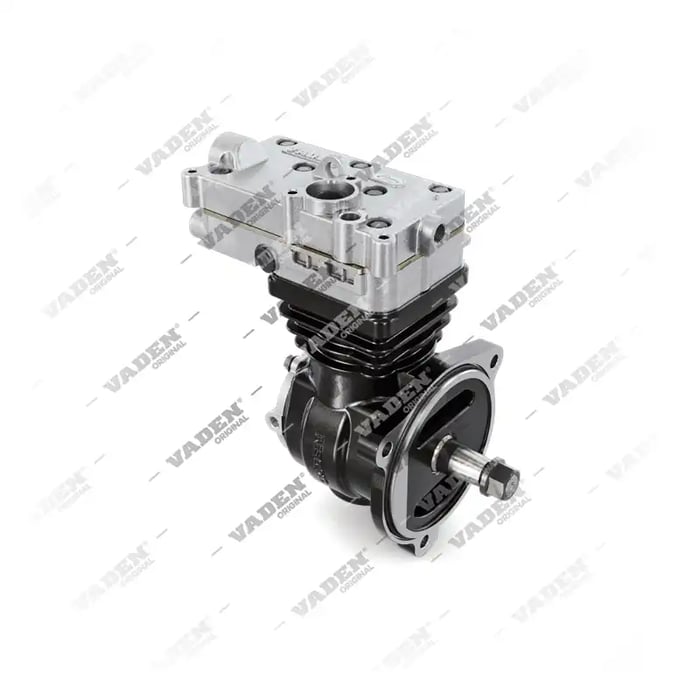
VADEN manufactures OE-grade air brake compressors, compressor components and repair kits for heavy commercial vehicles. We do not sell Haldex-branded parts; brand names here are used only as OE reference so you can identify what is already on the vehicle.
Replacing Haldex components correctly
- Read the unit. Take the part number and date code from the casting, label or data plate — the trailer VIN alone often misses a mid-life build change.
- Record the configuration. For EBS or ABS, pull the stored parameters with a diagnostic tool before removing the old modulator.
- Check the mating parts. Camshaft spline count and offset on adjusters; chamber stroke and mounting stud spacing; port size and thread form on valves.
- Depressurise safely. Drain the reservoirs, chock the wheels, and cage spring brakes before removing chambers.
- Torque to spec. Use the vehicle or component manufacturer's current service manual figures for caliper, chamber and adjuster fasteners.
- Test before release. Build to a fully charged system of about 120 psi, confirm governor cut-out and cut-in, verify the low-air warning near 60 psi, check for leaks, then measure pushrod stroke at every wheel and road-test.
Common faults and first checks
- One wheel out of adjustment — suspect the adjuster clutch, cam bushings or a collapsed shoe return spring, not just adjustment.
- Trailer brakes dragging — look for a stuck relay or EBS exhaust, a kinked line, or a chamber that is not fully returning.
- Uneven braking between axles — check load sensing valve linkage and ride height before condemning foundation brakes.
- ABS lamp on after repair — sensor gap, tone ring damage, or an unconfigured control unit.
- Dryer purging repeatedly — a downstream leak, or a compressor running far more than it should.
Treat the pressures quoted here as typical ranges for orientation. The vehicle and component manufacturer's current service literature is the governing authority for every figure you apply on the shop floor.
If the trail ends at supply rather than at a valve — slow build-up, a dryer purging on every cycle — the part to replace is the compressor itself, and VADEN builds air brake compressors for these fitments.
Need the part, not just the answer?
OE-grade air brake compressors and repair kits, manufactured and tested to commercial-vehicle standards.
Shop VADEN partsPublished by VADEN Original. Product links point to the manufacturer’s official catalogue. Specifications are general — always confirm figures against your vehicle’s service manual.