 airbrakecompressor
A spin-on air dryer carries its desiccant in a sealed canister that threads onto the dryer base like an oil filter. A cartridge-style dryer keeps the desiccant inside the dryer housing, behind a bolted end cover or a threaded retainer that has to be opened on the truck. Both remove the same water and oil vapor from the same compressed air and both purge at governor cut-out, so the real decision is about service time, what else you renew during the job, and whether you want a coalescing oil-removal stage built into the replaceable part.
What both designs are doing
Air leaves the compressor hot and loaded with water vapor and a trace of oil. The discharge line cools it, moisture drops out, and the dryer's desiccant bed adsorbs what is left before the air reaches the wet tank. When the governor reaches cut-out — typically somewhere in the 120-135 psi range — it unloads the compressor and signals the dryer's purge valve. That purge blast dumps the collected water and oil sludge out the exhaust and back-flows a small charge of dry air through the bed to regenerate it. When tank pressure falls to cut-in, usually around 100-110 psi, the compressor loads again and the cycle repeats, holding a healthy system near 120 psi.
That is the same story on every unit covered in our truck air dryer overview. Nothing about spin-on versus cartridge changes the physics. What changes is how you get the spent desiccant off the truck.
Spin-on dryers
On a spin-on unit the desiccant, the internal check valve and often the oil separator media all live inside one disposable canister. The base — with the purge valve, heater and port fittings — stays bolted to the frame rail or bracket permanently.
Service is close to an oil filter change: drain the reservoirs, confirm the system is at zero, unscrew the old canister (a strap or cap wrench for a stuck one), wipe the sealing face, lightly oil the new gasket, then hand-tighten and turn the additional fraction of a turn the canister's own label specifies. No housing comes apart, no bolt torque sequence, no loose o-rings to drop in the dirt. On a roadside or a busy shop floor that matters.
The trade-off is that the purge valve, exhaust seat and heater assembly in the base are not renewed with the canister. Those are separate repair kits, so a base that has been purging for years can keep leaking or blowing wet air even with a fresh cartridge on it.
Cartridge (housing-serviced) dryers
On the classic cartridge design the desiccant sits in a metal basket inside the dryer body. You remove the end cover fasteners or unthread the cartridge from inside, swap the desiccant unit and its o-rings, then reassemble to a specified torque. Most OE kits for these units bundle the purge valve seat, exhaust diaphragm and seals with the desiccant, so a proper service renews the wear items the spin-on canister leaves behind.
It takes longer and it is less forgiving. Cover bolts are usually a spring-loaded assembly that must be released and torqued in the sequence the manual gives, and a pinched o-ring turns into a slow leak that shows up as a compressor that cycles constantly. Working procedure is covered step by step in our air dryer cartridge replacement guide.
Side-by-side comparison
| Factor | Spin-on canister | Replaceable cartridge |
|---|---|---|
| Typical service time | Roughly 15-30 minutes once air is dumped | Roughly 30-60 minutes, more if fasteners are corroded |
| Tools | Filter/strap wrench, drain wrench | Sockets, torque wrench, o-ring pick |
| What gets renewed | Desiccant, internal check valve, separator media | Desiccant plus purge valve, seals and diaphragm in most kits |
| Purge valve service | Separate base repair kit | Usually part of the same kit |
| Coalescing option | Available as a higher-spec canister or add-on filter | Available as a coalescing cartridge or inline filter |
| Common failure mode | Aged base leaking or not purging under a new canister | Pinched o-ring or under-torqued cover after service |
| Part cost pattern | Higher part price, lower labor | Lower part price, higher labor |
| Best suited to | Owner-operators, quick PM lanes, roadside work | Shops doing scheduled full rebuilds of the dryer |
Where coalescing fits in
Standard desiccant handles water well and oil only incidentally. A coalescing stage adds media that traps fine oil aerosol before it reaches the desiccant, protecting the bed and keeping downstream valves cleaner. You will find it as a premium spin-on canister, as a coalescing desiccant cartridge, or as a standalone filter plumbed after the dryer — see the detail in our write-up on the coalescing oil filter for air dryers.
Be clear about what it is for. Coalescing media manages normal carryover on units with air suspension, air-operated accessories or high duty cycles. It does not compensate for a compressor pumping oil — that condition kills desiccant quickly, and the fix is the compressor, plus a system decontamination.
Intervals and cost thinking
OE schedules vary widely by duty cycle, from about annually on hard-working vocational equipment out to two or three years on lighter linehaul service. Ignore internet rules of thumb and follow the chassis and dryer manufacturer's interval. Two field checks tell you more than a calendar: drain each reservoir and look for water or gray emulsion, and listen for the purge "pop" at cut-out. Water in the tanks or a dryer that never purges means service is due regardless of mileage.
On total cost the two styles land close together. Spin-on canisters generally cost more as a part but save labor; cartridge kits cost less but eat shop time and sometimes a second trip if a seal is disturbed. The bigger variable is whether the base or housing hardware gets attention. Budget a purge valve or governor kit alongside the desiccant on a high-hour unit, and source matched OE-grade air dryer valves and service components rather than mixing odd parts across brands.
How to tell what you have and order correctly
- Look at the top of the dryer. A separate canister with a filter-style crimped seam and a gasket ring is spin-on; a one-piece body with a bolted cover or cast end is cartridge-served.
- Read the casting or label for the OE number on the dryer body, not just the cartridge. Same-looking bodies take different desiccant volumes and thread pitches.
- Note the heater connector and voltage while you are there; a dead heater is a winter freeze-up waiting to happen.
- You cannot convert one style to the other by swapping cartridges. Changing styles means a different dryer assembly, with its own bracket, plumbing and wiring.
Before you touch it
Chock the wheels and drain every reservoir to zero before opening any dryer. As system pressure bleeds down the low-air warning sounds near 60 psi and the spring brakes will set on their own somewhere in the 20-45 psi range — you do not want that happening while the truck is on a hill or in gear. Verify zero at the gauge and crack a drain valve to confirm before loosening anything.
After service, build the system back up, listen for a clean purge at cut-out, and check the dryer base and cover for leaks with soapy water at full pressure. A dryer that hisses continuously between cycles is telling you the purge valve or a seal did not seat.
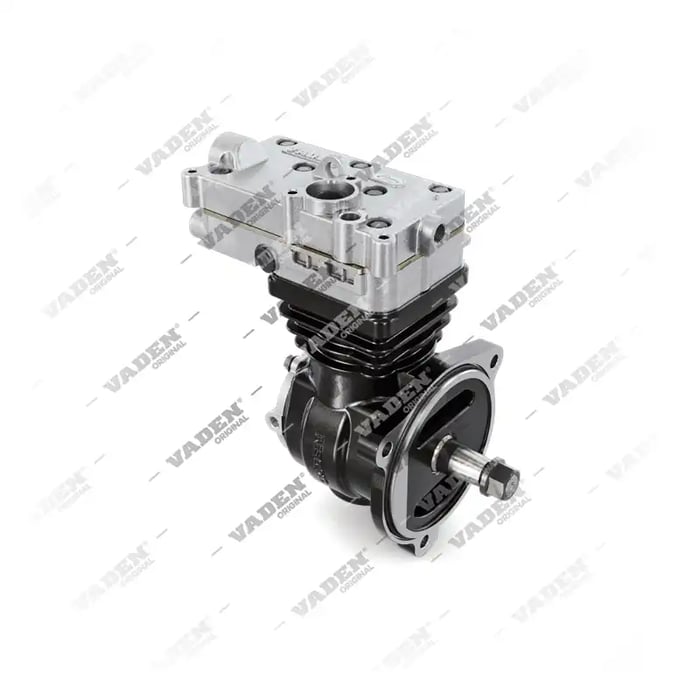
Need the part, not just the answer?
OE-grade air brake compressors and repair kits, manufactured and tested to commercial-vehicle standards.
Shop VADEN partsPublished by VADEN Original. Product links point to the manufacturer’s official catalogue. Specifications are general — always confirm figures against your vehicle’s service manual.