 airbrakecompressor
A brake chamber caging tool — also called a caging bolt, release bolt or release stud — is a T-headed bolt with a washer and nut that mechanically compresses the power spring inside a spring brake chamber, so the parking brake releases without any air pressure. It is the approved way to move or work on a vehicle whose air system is down, and it is a required step before you unbolt a spring chamber off the axle. The tool holds the spring back; it does not repair anything.
Why a spring brake has to be caged
The parking half of a piggyback chamber works backwards from the service half. A heavy coil spring pushes the pushrod out and applies the brake, and system air pushes the spring back and holds it off. That is why the brakes set themselves when a truck bleeds down: the springs begin to apply somewhere around 20-45 psi, well below the low-air warning near 60 psi and far below the roughly 120 psi you see on a fully charged system. Cut the air and the spring wins, every time.
So on a dead vehicle the spring is fully extended and the foundation brake is applied hard. The caging stud reaches through the back of the chamber, grabs the plate the spring pushes on, and winds it back — doing by hand exactly what the air was doing. If you are not clear on how the two halves stack together, start with the brake chamber basics.
What the tool actually consists of
Most caging tools are three pieces: a threaded stud with a T-shaped or flat-blade head, a heavy washer, and a nut. The T-head passes through the access hole in the center of the chamber's end cap, drops into a keyway in the internal pressure plate, and locks when you turn it 90 degrees. The washer bears on the outside of the chamber and the nut pulls the stud — and the spring — outward.
Nearly every new spring chamber ships with its own stud, usually clipped into a storage pocket on the chamber body or stowed in a hole in the housing. Keep it there. If yours is missing, buy the service stud that the chamber maker lists for that part number — Bendix, MGM, Haldex, Knorr-Bremse, Wabco/ZF and Meritor all supply them. Do not improvise with a hardware-store bolt: length, thread pitch, T-head width and, above all, bolt grade are all specific. A low-grade substitute can stretch or snap under spring load and leave the tool as a projectile.
Sizes and lengths: picking the right stud
There is no single universal caging bolt. The two things that decide fitment are the T-head width, which must match the keyway in the pressure plate, and the usable stud length, which must be long enough to pull the spring all the way back.
| What you are working on | Tool you need | Watch for |
|---|---|---|
| Standard-stroke spring chamber (24/24, 30/30 standard) | The short release stud supplied with that chamber | T-head must seat and lock, not just pass through the hole |
| Long-stroke chamber (30/30 LS and similar) | A longer release stud | A standard-length stud can run out of thread before the spring is fully caged |
| Replacement piggyback section | The stud in the new box | Transfer it to the chamber's storage pocket instead of leaving it in the toolbox |
| Sealed or "non-caging" chambers | None — there is no access hole | Replace as a unit; never open one |
| Lost or bent stud | OE service kit for that chamber | Never substitute an ungraded bolt or a longer nut-and-stud from another maker |
Nut sizes vary by manufacturer; a common 3/4 in. socket covers many of them, but check before you crawl under so you are not guessing on your back. Carry the stud, a deep socket, a hand ratchet and a set of chocks together — they are one kit, not four separate items.
How to cage a spring brake safely
- Chock the wheels on both sides, front and back. Caging releases the parking brake, so the vehicle can roll the moment the spring lets go.
- If the compressor still works, charge the system to full pressure and release the parking control first. The air is now holding the spring off, and the stud only has to hold position — far less load on the tool and on you.
- Pull the access plug or dust cap from the center of the chamber's end cap and keep it where you will find it again.
- Slide the stud in, seat the T-head in the internal keyway, rotate it 90 degrees and pull back until it locks.
- Fit the washer against the chamber face and start the nut by hand.
- Tighten with a hand ratchet only, watching the pushrod retract. Stop when the spring is fully caged and the pushrod is home.
- Apply the parking control or dump the air and confirm the pushrod stays retracted and the slack adjuster does not move. That is your proof the spring is captured.
The full walkthrough with photos-level detail lives in our step-by-step caging guide.
Never cut, torch, weld or drill a spring brake chamber, and never remove the clamp ring on the spring side of a piggyback. The power spring stores enough energy to kill. Cage the chamber, tag it, and scrap it whole following the manufacturer's disposal instructions.
Torque and travel limits
Chamber makers generally cap caging-nut torque around 50 lb-ft. That is a hand-ratchet figure, not an impact-gun figure. Air tools overshoot instantly, strip the stud threads or pull the T-head through the pressure plate, and the stored spring energy does the rest.
Travel tells you something too. If the nut bottoms out and the brake is still applied, stop and think: you may have the wrong stud length for a long-stroke chamber, the T-head may not be seated in the keyway, or the power spring may already be broken and jammed inside. Do not lean on the ratchet to make it go.
Uncaging and closing up
To release, back the nut off slowly with the ratchet — with the system charged if possible — until spring pressure is off the stud, then turn the T-head 90 degrees and withdraw it. Reinstall the access plug or dust cap. That plug is not decoration: leaving the hole open lets water, salt and road spray into the spring cavity, and a corroded power spring is how chambers fail in service. Return the stud to its pocket on the chamber.
What caging will not fix
A caging tool is a workaround, not a repair. If you had to cage a chamber to move a truck, something upstream is wrong — a leaking chamber diaphragm, a dead compressor, a stuck valve, or a broken power spring. If the brake stays dragging even after the chamber is caged, the fault is mechanical in the foundation brake: a seized S-cam, a frozen slack adjuster, or a wedged shoe. Work through why a spring brake will not release before you assume the chamber is the culprit, and never leave a caged chamber on a vehicle that goes back into service.
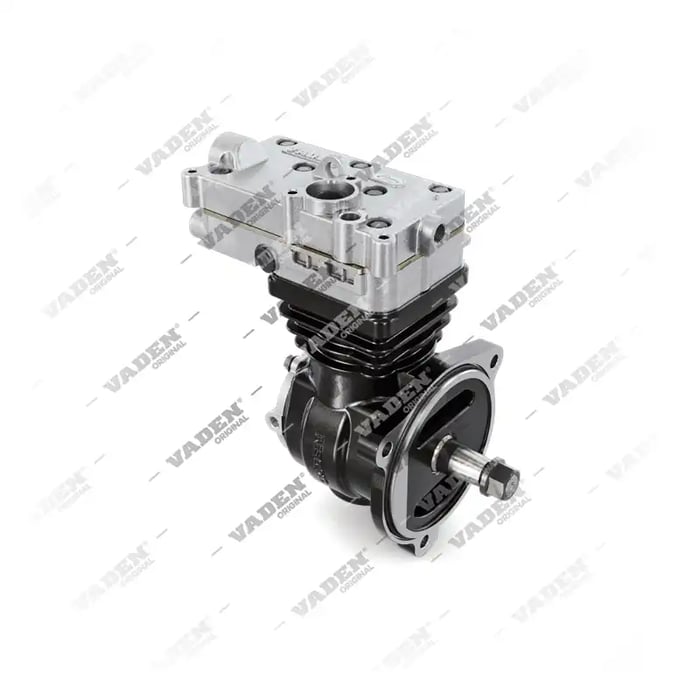
Need the part, not just the answer?
OE-grade air brake compressors and repair kits, manufactured and tested to commercial-vehicle standards.
Shop VADEN partsPublished by VADEN Original. Product links point to the manufacturer’s official catalogue. Specifications are general — always confirm figures against your vehicle’s service manual.