 airbrakecompressor
A thermostatic drain valve is an automatic, electrically heated drain fitted at the bottom of a truck's wet tank, or into a small auxiliary "ping tank" hung below it, that expels collected water, oil and sludge on its own every time system pressure drops slightly. The thermostat handles the winter half of the job: it switches an internal heating element on only when the valve gets cold, so the seat and the exhaust port cannot freeze shut with water sitting in them. On a healthy truck you hear a short, sharp spit of air under the chassis each time you make a brake application or the governor cycles. That sound is the valve working.
How the valve actually opens
Most automatic tank drains in heavy-truck service, including the widely used Bendix DV-2 style, are pressure-differential devices. Reservoir pressure holds an internal valve seated against its port. When tank pressure falls by a few psi, which happens on every brake application, every air suspension dump, and every governor unload-and-reload cycle, the differential across the valve unseats it. Liquid sitting at the very bottom of the tank is blown out through the exhaust port along with a slug of air. As the compressor brings the system back up toward the normal cut-out band of roughly 120 to 135 psi, the valve reseats and holds.
There is nothing to time and nothing to adjust. The valve simply lives off the normal breathing of the air system. The catch is that it can only expel what physically reaches it, which is why mounting position matters more than anything else with these valves. If the valve is not at the true low point of the reservoir, water pools somewhere else and the drain looks like it is working while the tank slowly fills.
Why a ping tank exists
Plenty of chassis have no room to hang a drain valve directly out of the reservoir's bottom port. Frame rails, crossmembers, fuel tanks, battery boxes and ground clearance all get in the way, and a valve buried above a crossmember is a valve nobody ever services. The fix is a ping tank: a small auxiliary reservoir, well under a gallon, mounted below the main wet tank and plumbed to its lowest port with a drop line.
The ping tank becomes the new low point of the system. Condensate gravity-drains down into it, and the automatic drain valve mounts in the ping tank where a tech can reach it. Two plumbing rules keep it honest. The drop line must fall continuously from the reservoir to the ping tank, because any sag becomes a water trap that freezes solid in winter. And the ping tank must sit below the reservoir, not beside it. Get either wrong and you have added a part without moving any water.
The thermostat and heater circuit
Liquid water inside a drain body is a freeze waiting to happen, and a frozen drain is worse than no drain. The heated version carries a small element in the valve body with a self-regulating thermostat. It energizes when the body cools to somewhere around 40 F (about 5 C) and shuts off once the valve warms back up, typically in the 80 to 90 F range. Current draw is small, on the order of a couple of amps on a 12-volt circuit, and the lead is normally fed from a fused ignition or battery source. There is no dash switch and nothing for the driver to remember.
Because the heater does nothing for most of the year, the circuit fails silently. A chafed lead, a corroded connector, a blown fuse or an open element gives zero symptom until the first cold night, and then the drain either freezes shut, so water accumulates and migrates downstream into valves and brake chambers, or freezes with debris on the seat and leaks continuously. Verify it during fall PM: check for voltage and current draw at the connector with the valve cold, or measure element resistance against the manufacturer's spec. More background on where that moisture comes from is in our page on water in air tanks.
It backs up the air dryer, it does not replace it
On a modern truck the air dryer does the heavy lifting, pulling moisture and oil out of the charge air before it ever reaches the reservoirs and purging it at every governor cut-out. The tank drain catches what gets past: carryover from a saturated desiccant cartridge, high duty cycle work in humid weather, or oil pushed through by a worn compressor. That makes the ping tank discharge a useful diagnostic. Clear air with a light spray of water is normal. Steady water volume or a milky grey oil emulsion means the dryer cartridge or the compressor needs attention, not the drain valve.
Diagnosing a drain that has quit
| Symptom | Likely cause | What to check |
|---|---|---|
| No ping heard, tanks give up a lot of water when cracked manually | Valve stuck closed, exhaust port plugged with sludge or ice | Pull the manual release; if nothing comes out, remove and clean or replace the valve |
| Constant leak at the drain, compressor cycling far more than normal | Debris on the seat, worn seal, or frozen open | Clean the seat, then replace if it will not hold; measure system air loss rate |
| Works all summer, fails every winter | Dead heater circuit | Fuse, ground, connector corrosion, element resistance |
| Heavy water or oily discharge every cycle | Saturated dryer cartridge or compressor passing oil | Cartridge service interval, discharge line condition, compressor oil carryover |
| Valve cycles normally but tanks still hold water | Valve not at the true low point, or a sagging drop line | Tank slope, drop line routing, ping tank mounting height |
Service and replacement
At every PM, pull the manual release ring or stem two or three times with the system fully charged, around 120 psi, and confirm a strong discharge of air and liquid. That single check catches most failures. Also listen for the valve during a brake application with the engine shut off, and note whether the discharge quantity has changed since the last service.
Before loosening any fitting, drain the system to zero. A reservoir sitting at cut-out pressure will launch a valve body or a fitting hard enough to injure someone.
When replacing the valve, use a pipe sealant rated for air brake service rather than PTFE tape, since shredded tape migrates downstream and lands on a valve seat. Aim the exhaust port down and away from wiring harnesses, brake chambers, air lines and the driveline, and tighten to the manufacturer's torque figure instead of leaning on it, because over-tightening cracks the tank boss. Never plug a leaking drain and call it repaired: you have then removed the moisture protection and left the leak's root cause in place.
Finally, an automatic drain does not retire the manual routine. Most fleets still crack the tanks by hand on a set interval to see what is actually accumulating, and that habit is worth keeping. Our guide to draining air tanks covers the order to do it in and what the discharge should look like.
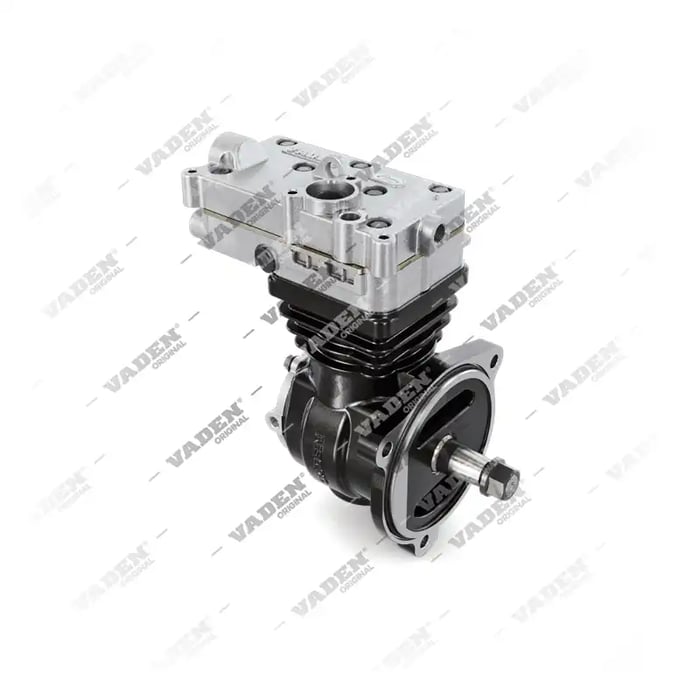
Need the part, not just the answer?
OE-grade air brake compressors and repair kits, manufactured and tested to commercial-vehicle standards.
Shop VADEN partsPublished by VADEN Original. Product links point to the manufacturer’s official catalogue. Specifications are general — always confirm figures against your vehicle’s service manual.