 airbrakecompressor
If your air brake compressor is not building pressure, the cause is usually outside the compressor itself: an air leak, a stuck unloader, a faulty governor, or a clogged air dryer will all starve the system even when the pump is healthy. Work through the causes below in order — cheapest and most common first — and confirm the fault before you replace anything. Only a worn or damaged compressor actually needs a new pump; the rest are valves, lines, and adjustment.
A quick baseline first: with the engine at fast idle (around 600-900 rpm), a sound dual-circuit system should build from about 85 to 100 psi in under a minute and reach governor cut-out (typically ~120-135 psi) shortly after. If yours takes several minutes, stalls at a low number, or never trips the governor, use this guide.
Quick diagnostic table
| Cause | Symptom you'll notice | How to check | Typical fix |
|---|---|---|---|
| Air leak | Pressure builds then bleeds off; audible hiss; buildup can't keep up with demand | Charge to cut-out, shut engine off, listen and soap-test fittings, chambers, glad hands | Reseal or replace the leaking line, fitting, chamber, or valve |
| Unloader stuck open | Compressor runs but no air reaches the tanks; air escaping at the compressor head/governor | Listen at the unloader; check governor signal line for constant air | Rebuild or replace unloader / governor |
| Governor fault | Compressor never loads, or cuts out far too low | Compare cut-in/cut-out to spec (~100-110 / ~120-135 psi); tap or bench-test | Replace or readjust the governor |
| Clogged air dryer | Slow buildup, moisture in tanks, dryer purges constantly or not at all | Feel for restriction; temporarily bypass to compare buildup | Replace desiccant cartridge or dryer |
| Worn compressor | Slow buildup everywhere, oil in the discharge line, blue haze from the crankcase vent | Time the 85-to-100 psi buildup; inspect discharge for carbon/oil | Overhaul or replace the compressor |
| Drive belt slipping | Squeal on load, slow buildup, glazed belt (belt-driven units only) | Inspect tension and belt condition | Tension or replace the belt |
1. Air leaks (check this first)
Leaks are by far the most common reason a system "won't build." The compressor may be pumping fine, but air escapes as fast as it's made. Charge the system to cut-out, shut the engine off, chock the wheels, and release the brakes. Listen. A leak-down faster than about 2 psi per minute on a single vehicle (brakes released) — or roughly 3 psi per minute on a combination vehicle — is out of spec. Spray soapy water on fittings, glad-hand seals, the air dryer purge valve, brake chambers, and every threaded joint; bubbles pinpoint the leak. Fix it and retest before touching the compressor: a system that charges but then slowly bleeds down over minutes or hours has a sealing problem, not a pumping one. And if a leak ever lets pressure sag toward the low-air warning threshold (around 60 psi), the dash buzzer and warning light should trigger — never drive a truck that can't hold pressure comfortably above that.
2. Unloader valve stuck open
When the governor reaches cut-out, it sends air to the compressor's unloader, which holds the intake valves open so the pump idles without compressing. If that unloader sticks open — from carbon, wear, or a bad seal — the compressor spins but never pumps air into the tanks. You'll often hear air puffing at the compressor head. Check that the governor is only signaling the unloader at cut-out, not constantly. A sticky or worn unloader valve is a classic cause of "compressor not building air" and is usually cured with a rebuild kit rather than a whole new compressor.
3. Governor fault
The governor decides when the compressor loads and unloads. If it's stuck in the unload position or wildly misadjusted, the compressor never builds. Compare cut-in and cut-out to spec — cut-in around 100-110 psi, cut-out around 120-135 psi. A governor that trips out far too early, or one whose signal line is plugged, leaves you chronically low on air. Read more on how the compressor governor controls the cycle. Governors are inexpensive and are usually replaced rather than repaired.
4. Restricted air dryer or discharge line
All the compressor's output passes through the discharge line and (on most rigs) the air dryer before reaching the tanks. A saturated desiccant cartridge, a frozen dryer in winter, or a discharge line packed with oil-carbon buildup acts like a partially closed valve — buildup crawls and moisture shows up downstream. Temporarily bypassing the dryer to compare buildup speed is a quick confirmation. If the dryer is the choke point, replace the cartridge. See our overview of the truck air dryer for service intervals.
5. Worn or damaged compressor
If leaks, unloader, governor, and dryer all check out and buildup is still slow everywhere, the compressor itself may be worn. Look for oil in the discharge line, excessive oil passing to the dryer, and long buildup times. Worn rings, scored cylinders, or leaking discharge valves let the pump lose what it makes on every stroke. At that point, plan an overhaul or replacement with a genuine OE-grade air brake compressor. If the pump is otherwise sound and only the valve plate or unloader is worn, compressor repair and unloader kits restore output for a fraction of the cost of a new unit.
6. Drive belt (belt-driven units)
Gear-driven compressors don't have this issue, but belt-driven pumps can slip under load. A glazed or loose belt squeals and can't spin the compressor fast enough to keep up with demand. Inspect the belt and tensioner and replace a worn belt before condemning anything upstream.
Rule of thumb: a compressor that spins but makes no air points to the unloader or governor; slow buildup everywhere points to a leak, dryer restriction, or a worn pump. Confirm which before you spend money.
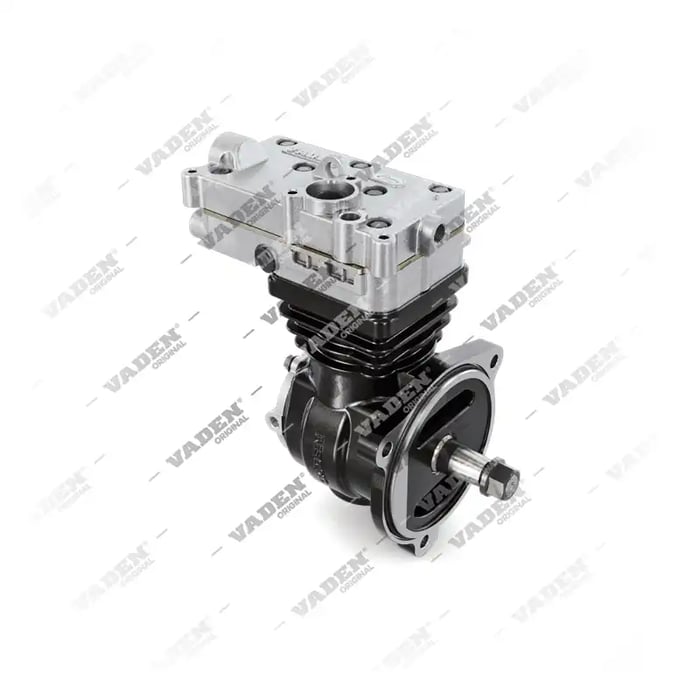
Need the part, not just the answer?
OE-grade air brake compressors and repair kits, manufactured and tested to commercial-vehicle standards.
Shop VADEN partsPublished by VADEN Original. Product links point to the manufacturer’s official catalogue. Specifications are general — always confirm figures against your vehicle’s service manual.