 airbrakecompressor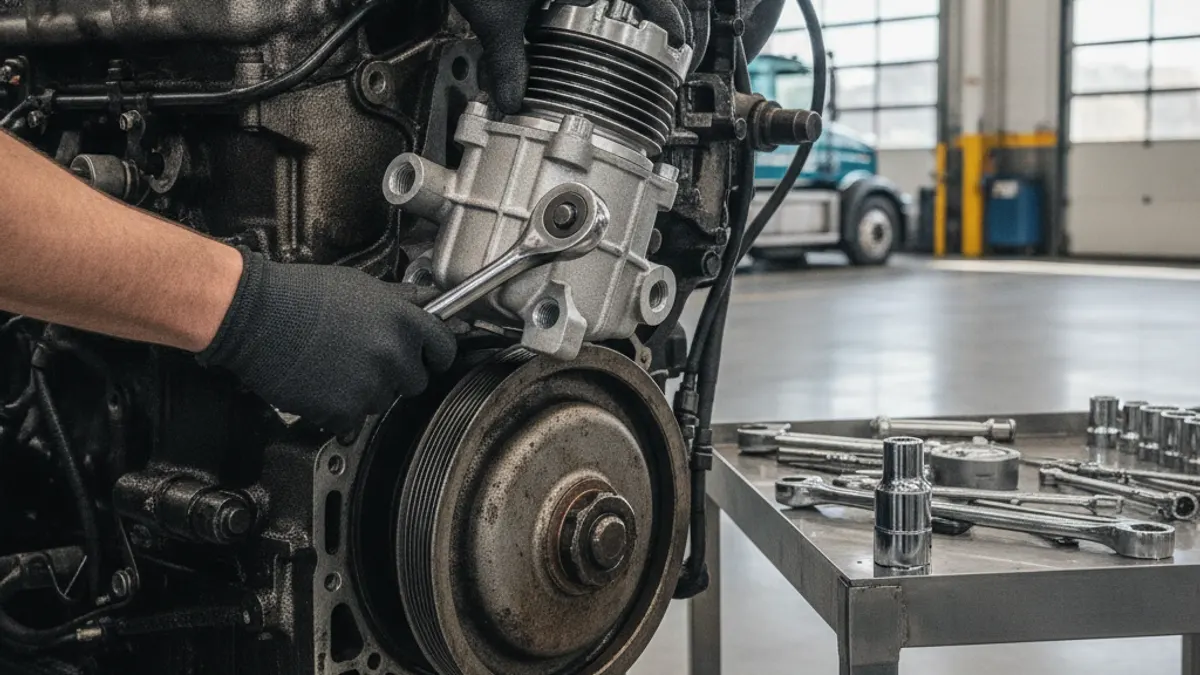
Replacing an air brake compressor is a straightforward mechanical job, but on a heavy truck it comes with two hazards a car mechanic never sees: the system stores compressed air at roughly 120 psi when fully charged, and the compressor is usually cooled by hot engine coolant and fed by engine oil. Before anything else, drain every reservoir to 0 psi and let the engine cool. Then it's a matter of disconnecting the air, coolant, and oil lines, unbolting the unit, fitting the replacement, priming it, and leak-testing. This guide walks through when to replace versus repair and how to do the swap cleanly.
Repair or replace? Decide first
An air brake compressor is a rebuildable pump. The valve plate, piston rings, unloader assembly, and gaskets all wear and can be renewed with an OE-grade compressor repair kit if the core casting is still healthy. The problem is that the failures that actually strand a truck — worn cylinder bores, crankshaft bearing knock, a cracked head — are the ones a kit won't fix. Use this rule of thumb:
| Repair (kit) makes sense when… | Replace the compressor when… |
|---|---|
| Bore and crankshaft are within spec, no scoring | Cylinder wall is scored or glazed; visible aluminum transfer |
| Leaking or sticking unloader, worn valve plate | Crankshaft knock or excessive bearing play |
| Weeping head or base gasket only | Cracked head, block, or stripped mounting flange |
| Low mileage, known-good unit | High-hour unit that has been passing oil for months |
If the unit has been pumping oil downstream, be skeptical of a quick kit fix — chronic oil passing usually means worn rings and bore, and you'll be back under the truck in a month. In that case a new or reman compressor is the smarter spend.
Tools and parts to have on hand
- New or reman compressor (correct part number, port and drive configuration)
- New mounting gasket/O-rings and, ideally, a new discharge line
- New air dryer cartridge (change it at the same time — see below)
- Engine oil and coolant to top off after the job
- Torque wrench, line wrenches, drain pan, thread sealant rated for air
- Spray bottle of soapy water for leak testing
Step-by-step replacement procedure
The exact routing varies by engine, so treat this as the high-level sequence and confirm details against the vehicle's service manual.
- Depressurize and secure the truck. Chock the wheels, shut the engine down, and open every reservoir drain valve until the dash gauges read zero. Do not proceed until the whole system is at 0 psi.
- Let it cool and drain coolant. On a coolant-cooled compressor, let the engine cool, then drain coolant down to below the compressor head so you don't dump it everywhere when the lines come off.
- Disconnect the lines. Cap or label as you go: the discharge (delivery) air line, the coolant supply and return, the oil feed and return, the air intake/supply line, and the unloader control line coming from the governor.
- Unbolt and remove. Support the compressor's weight — many units run 30–60 lb (roughly 14–27 kg). Remove the mounting bolts at the flange or gear housing and ease the unit out. Note: standard air compressors are not valve-timed to the engine, so you don't need to set timing marks like a cam gear.
- Clean the mating surface. Scrape old gasket material off the mounting face without gouging it. Fit the new gasket or O-rings dry unless the manual specifies sealant.
- Install the new compressor. Set it on the mount, start all bolts by hand, then torque in sequence to the manufacturer's spec. Reconnect coolant, oil, intake, and the unloader line. Fit a new discharge line if you have one.
- Prime it with oil. Pre-fill the crankcase per the instructions and build oil pressure before the compressor runs dry. On many installs you crank the engine with fuel shut off, or idle briefly, to get oil to the compressor before it sees load.
- Refill and bleed coolant. Top off coolant, purge air from the cooling system, and check oil level.
- Build pressure and leak test. Start the engine, let the system charge, and confirm the governor cuts out in the normal ~120–135 psi range. Spray every joint with soapy water and watch for bubbles. Fix any weep before the truck moves.
Don't skip the downstream cleanup
This is the step that separates a lasting repair from a repeat failure. A compressor that failed — especially one that passed oil — pushes contamination into the discharge line, the air dryer, and the wet tank. Bolt a fresh compressor onto a fouled system and it inherits that mess:
- Flush or replace the discharge line. Oil and carbon coke build up here and can restrict flow or carry contamination forward. A new line is cheap insurance.
- Change the air dryer cartridge. Oil kills desiccant. Installing a new compressor behind a saturated truck air dryer means moisture and oil march straight into your valves and reservoirs. Replace the cartridge as part of the job.
- Drain and flush the reservoirs. Pull the drains and clear any accumulated oil and sludge from the wet tank before recharging.
When you source the replacement, match it to the original's displacement, cooling type, and port layout. VADEN's range of OE-grade air brake compressors covers the common single- and twin-cylinder configurations for European and North American trucks, so you can cross-reference by the number stamped on the old unit rather than guessing.
After the job: verify it holds
Once everything is buttoned up, run the truck through a full charge cycle and a leak-down check. Build to cut-out, shut the engine off, and watch the gauges — a properly sealed system should lose only a few psi per minute with the brakes released. Confirm the governor cuts back in around ~100–110 psi and that the compressor unloads quietly. If pressure builds slowly or the compressor won't reach cut-out, revisit the intake and discharge connections before you sign off. For a sense of parts-and-labor pricing before you commit, see our breakdown of air brake compressor replacement cost.
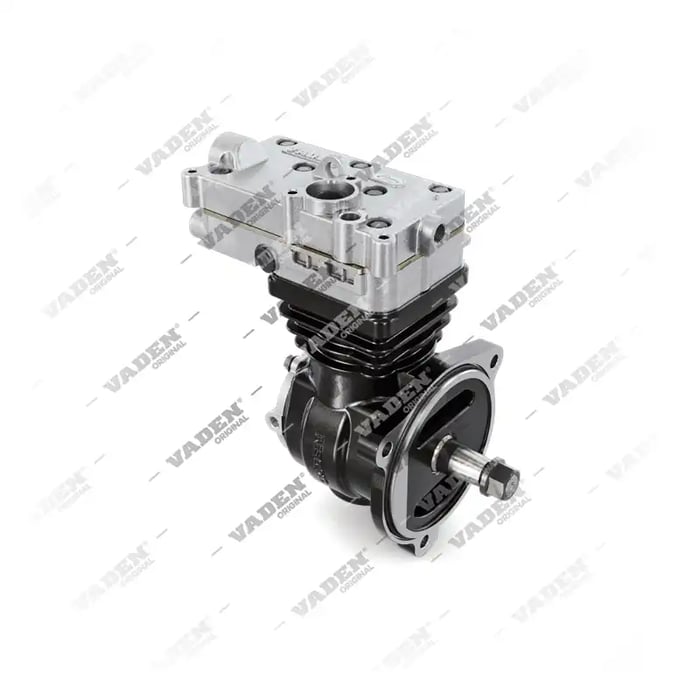
Need the part, not just the answer?
OE-grade air brake compressors and repair kits, manufactured and tested to commercial-vehicle standards.
Shop VADEN partsPublished by VADEN Original. Product links point to the manufacturer’s official catalogue. Specifications are general — always confirm figures against your vehicle’s service manual.