 airbrakecompressor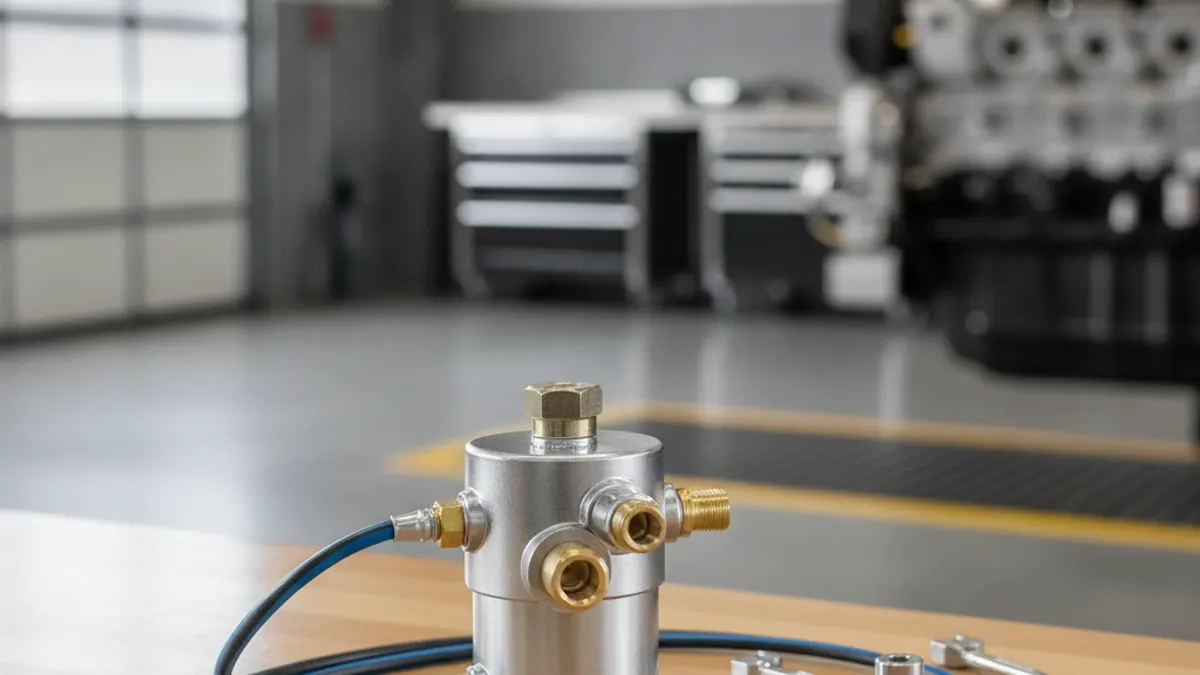
The air brake governor is the control that decides when the compressor pumps and when it coasts. It continuously senses pressure in the supply (wet) reservoir and switches the compressor between two states: loaded, where it actively pumps air, and unloaded, where it keeps spinning but stops building pressure. When the reservoir reaches the upper limit (cut-out), the governor unloads the compressor; when pressure falls to the lower limit (cut-in), it loads it again. That cycle is what keeps a heavy vehicle's air system inside its normal operating band instead of climbing until a safety valve blows.
What the governor actually does
The governor is usually mounted on or right next to the compressor, or on the firewall, and is plumbed to reservoir pressure. Inside it is a spring-loaded piston working against a set of exhaust and inlet valves. As system pressure rises against that piston, the governor holds off. Once pressure hits the cut-out setting, the piston moves and the governor sends an air signal down a line to the compressor's unloader valve. That signal lifts the inlet valves (or opens an unloader port) so the compressor pumps air in a circle instead of into the tanks. When pressure bleeds back down to cut-in, the governor vents that signal and the compressor loads again.
On systems with an air dryer, the same governor signal usually drives the dryer's purge. At cut-out, the governor both unloads the compressor and opens the air dryer purge valve to blow accumulated water and oil out of the desiccant. So a governor fault can quietly take your moisture control down with it.
Cut-out and cut-in pressure
These two numbers define your system's working range. Exact figures vary by vehicle and manufacturer spec, but they fall in a predictable band:
| Term | What happens | Typical range |
|---|---|---|
| Cut-out | Governor unloads the compressor; it stops building pressure | ~120-135 psi |
| Cut-in | Governor loads the compressor; it resumes pumping | ~100-110 psi |
| Differential | Spread between cut-in and cut-out | ~20-25 psi |
A healthy truck builds to cut-out, then holds. As you use air braking and pressure drops, it should fall no lower than cut-in before the compressor kicks back on. If you want the full picture of where these numbers sit relative to the low-air warning and parking-brake thresholds, see a fully charged air brake system's PSI.
Loaded vs. unloaded cycling
People assume the compressor stops turning when the tanks are full. It doesn't. On a typical engine-driven reciprocating compressor, it's geared to the engine and spins whenever the engine runs. The governor doesn't switch it off; it switches it between doing work and doing nothing:
- Loaded: inlet valves work normally, air is compressed and pushed to the reservoirs. Pressure climbs.
- Unloaded: the governor's signal holds the unloader open, so intake air just shuttles back and forth. Pressure holds steady, and the compressor runs cool with minimal load.
A normally sealed, leak-free system will sit unloaded for long stretches and only load briefly to top up. Frequent, short load cycles usually mean a leak somewhere, not a governor problem — but the governor is where the symptom shows up first.
Symptoms of a bad governor
A failing governor either stops unloading the compressor, unloads too early, or cycles erratically. Watch for these:
| Symptom | Likely governor issue |
|---|---|
| Pressure climbs well past cut-out until the safety valve vents (typically set around ~150 psi) | Governor not reaching cut-out; compressor never unloads |
| Rapid, constant cycling (loading and unloading every few seconds) | Narrow or unstable differential; sticking governor piston |
| Compressor unloads early and system never reaches full pressure | Cut-out set too low or governor bleeding the signal |
| Air dryer never purges (or purges constantly) | Governor signal line to the dryer faulty |
| Governor "spits" air continuously from its exhaust port | Worn internal valves/seals leaking |
Before condemning the governor, rule out a stuck-open unloader, a blocked or leaking signal line, and a worn compressor. A compressor whose unloader mechanism is seized can mimic a governor fault exactly. If the governor tests good but the compressor still won't unload or build to spec, the fault is inside the compressor head — and at that point you're looking at either a quality air brake compressor repair kit or a replacement unit rather than another governor.
Governor adjustment overview
Most conventional governors are adjustable within a limited range, but adjustment is a fine-tuning step, not a repair. General procedure — always confirm against the specific service manual and your dash gauge:
- Fan the brakes down and let the compressor build to cut-out. Note the reading on an accurate gauge.
- Loosen the adjusting lock and turn the adjusting screw: on many designs, turning it in raises cut-out and turning it out lowers it, roughly a few psi per quarter turn.
- Cut-in generally tracks with cut-out because the differential is largely fixed internally — you set cut-out, and cut-in follows about 20-25 psi below it.
- Rebuild pressure and re-verify both points. Confirm cut-out is within spec and the safety valve is not being reached.
Never wind up the cut-out setting to compensate for a system that won't hold pressure, or wind it down to quiet a noisy compressor. That masks the real fault and can push the system past safe limits. Fix the leak or the compressor, then set the governor.
If cut-out and cut-in have drifted out of range and won't hold an adjustment, the governor's internal valves are worn and it should be replaced — they're inexpensive relative to the risk. And if diagnosis points past the governor to the pump itself, browse OE-grade air brake compressors and match one to your engine and mounting. For how the governor fits into the wider charging circuit, see how air brake systems work.
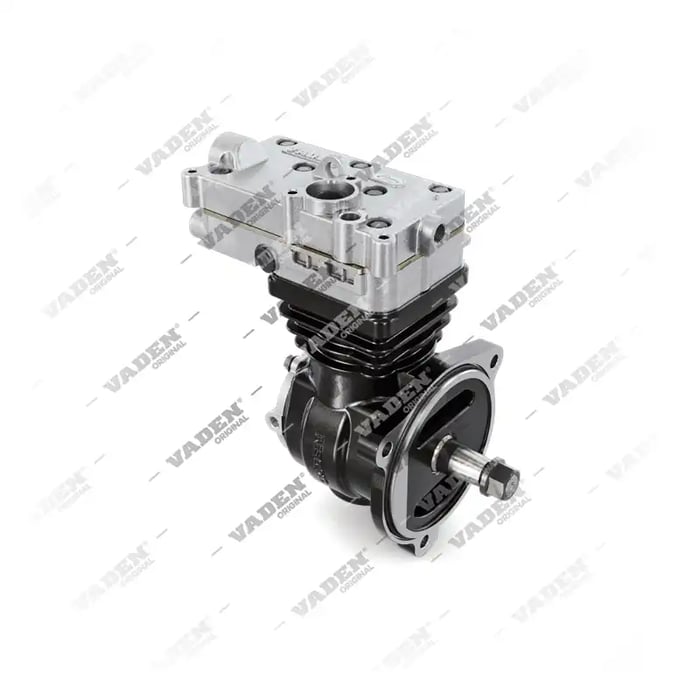
Need the part, not just the answer?
OE-grade air brake compressors and repair kits, manufactured and tested to commercial-vehicle standards.
Shop VADEN partsPublished by VADEN Original. Product links point to the manufacturer’s official catalogue. Specifications are general — always confirm figures against your vehicle’s service manual.