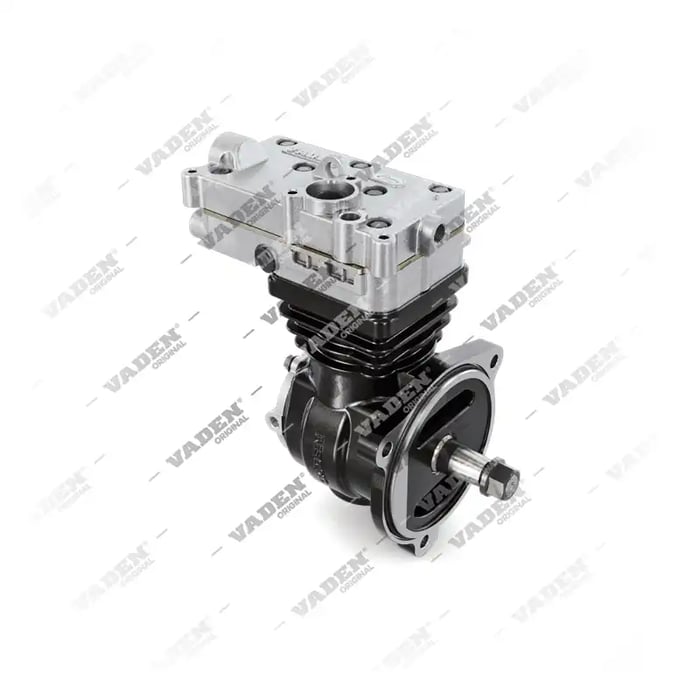
 airbrakecompressor
On a trailer, air disc brakes stop shorter, stay consistent when hot, and take most of the routine adjustment work out of the wheel end. Drum brakes cost less to buy, cost far less to reline, and tolerate salt, mud and long parked stretches with fewer surprises. Both are fed by exactly the same pneumatic circuit, so this is a decision about the foundation brake at the wheel, not about the air system behind it.
That last point matters when you are troubleshooting. Whichever foundation brake the trailer carries, the compressor and governor still cut out somewhere around 120-135 psi and cut back in near 100-110 psi, a fully charged system still sits around 120 psi, the low-air warning still comes on near 60 psi, and the spring brakes still start dragging on as pressure falls into the 20-45 psi band. Disc brakes do not change any of that; they change what happens after the air reaches the chamber. If you want the full circuit, see how a semi-trailer air brake system is plumbed.
The two designs, briefly
A drum trailer axle uses S-cam foundation brakes. Air pressure pushes the chamber pushrod, the pushrod swings the slack adjuster, the slack adjuster rotates the camshaft, and the S-cam turns against two rollers that force the shoes outward into the drum. Every one of those joints is a wear point and a lubrication point, and the whole thing depends on correct pushrod stroke to work at full effect.
A disc trailer axle uses an air-actuated caliper. The chamber pushrod acts on an internal lever and eccentric bearing, which multiplies the force through threaded tappets onto the inboard pad; the caliper then slides on its guide pins and clamps the rotor from both sides. An internal adjuster mechanism resets running clearance on every application, so there is nothing to set by hand. The wear parts are pads, rotor, guide pins and boots - see the truck air disc brake caliper breakdown for how the internals stack up, and for OE-grade air disc brake caliper components when you are rebuilding rather than replacing.
Disc versus drum on a trailer, side by side
| Factor | Air disc | S-cam drum |
|---|---|---|
| Stopping performance | Shorter, more repeatable, less affected by water | Adequate when in adjustment; falls off as stroke grows |
| Fade resistance | Strong - open rotor sheds heat, no drum expansion effect | Weaker - drum expands away from the shoes when hot |
| Wheel-end weight | Close to drum; varies with rotor and hub choice | Close to disc; heavy drum, light hardware |
| Adjustment | Internal and automatic; no external slack adjuster | Automatic slack adjuster, but stroke must still be checked |
| Lubrication points | Guide pins and boots only | Camshaft bushings, rollers, slack adjusters, anchor pins |
| Friction change labour | Fast - pads out through the caliper opening | Slower - hub off or drum off, shoes, springs, hardware |
| Parts cost | Higher for pads, much higher for rotors and calipers | Low; relined exchange shoes are inexpensive |
| Machining | Rotors are replaced, not resurfaced in most fleet practice | Drums can be turned to a stamped maximum diameter |
| Contamination tolerance | Seized guide pins and surface rust after long parking | Handles mud, salt and neglect with fewer failures |
Weight at the wheel end
Weight is the argument that gets overstated. A modern disc package trades a heavy cast drum for a rotor, caliper and carrier, and the net difference against a comparable drum wheel end is small - close enough that rotor material, hub choice and wheel spec move the number as much as the brake type does. If you are chasing payload on a tanker or a bulk trailer, weigh the two actual specs your builder offers rather than assuming disc is automatically lighter.
Heat and fade
This is where disc earns its keep. A drum is a closed bowl that traps heat, and as it heats it grows outward, away from the shoes, so the pushrod has to travel further for the same torque. On a long grade that shows up as a soft pedal and a trailer that stops pulling its share. A rotor sits in open air, sheds heat from both faces, and grows in thickness rather than away from the pads, so the clamping geometry barely changes. Trailers on mountain work, refuse routes, or anything with repeated heavy stops feel that difference first. It does not remove the need for correct engine braking and gear selection on a descent, but it widens the margin before fade.
Maintenance and labour hours
Disc removes an entire family of PM tasks: no pushrod stroke measurement, no slack adjuster greasing, no camshaft bushings, no S-cam rollers, no shoe return springs. A pad change is a fraction of the time of a shoe and hardware job, which matters when a trailer is only in the yard for a short window. In exchange you inherit new inspection points - guide pin freedom, boot condition, rotor cracking and pad thickness on both sides - and the discipline to service pins before they seize rather than after.
Inspection criteria differ too. Roadside enforcement on cam brakes leans on pushrod stroke and lining thickness; on disc it leans on pad thickness, rotor condition and whether the caliper moves freely. Thin disc pads put a unit out of service well before the pad backing touches, so check the current CVSA out-of-service criteria for your equipment rather than eyeballing it.
Cost over the trailer's life
Drum wins the parts invoice, disc wins the labour ticket, and which one wins overall depends on how the trailer is used. High-mileage linehaul with frequent friction changes tends to favour disc, because labour hours and downtime dominate. Low-mileage drop-and-hook trailers that spend more time parked than rolling tend to favour drum, because you rarely collect the labour savings and you do collect rusted rotors and stuck guide pins. Get current quotes for both foundation types on your actual axle spec; catalogue pricing moves with brand, volume and rotor design.
Mixing disc and drum
Pneumatically, a disc trailer behind a drum tractor - or the reverse - works fine, because the trailer control and supply lines are unchanged. What changes is how quickly each end develops torque, so the disc-equipped end does relatively more of the work early in an application. Mixing within a single trailer is legal on most specs but harder to keep balanced and harder to stock parts for; most fleets standardise one foundation type per trailer, and increasingly per fleet.
Which one to spec
Spec disc if the trailer runs grades, runs heavy, runs high annual mileage, or if your tractors are already disc and you want consistent feel across the combination. Stay with drum if the trailer is a low-mileage yard or regional unit, if it lives in heavy salt, or if your shop and parts network are already built around cam brakes and relined shoes. Neither choice is wrong - what is wrong is specifying disc and then treating it like a drum brake on the PM sheet, or keeping drums and letting the stroke creep out of range.
Need the part, not just the answer?
OE-grade air brake compressors and repair kits, manufactured and tested to commercial-vehicle standards.
Shop VADEN partsPublished by VADEN Original. Product links point to the manufacturer’s official catalogue. Specifications are general — always confirm figures against your vehicle’s service manual.