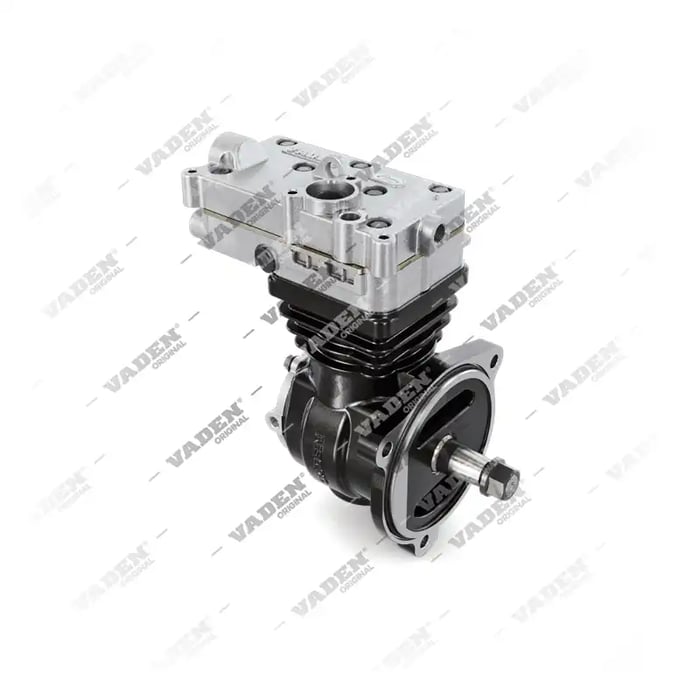
 airbrakecompressor
A two-way check valve — nearly everyone in the shop calls it a double check valve — is a small shuttle valve with two inlet ports and one outlet. Whichever inlet carries the higher pressure drives an internal shuttle across the bore, seals off the lower-pressure inlet, and passes its own pressure straight to the outlet. That single job lets two independent air circuits feed one device without letting them bleed into each other, which is why these valves sit behind the trailer service line, the stop lamp switch, the spring brake supply and most dash accessories.
How the shuttle picks a winner
Inside the brass or reinforced-composite body is a free-floating shuttle: usually a rubber-faced disc, a rubber-tipped plunger, or an O-ring sealed slug that travels a few millimetres between two seats. With no air anywhere it sits loose in the middle. Send pressure into port 1 and the shuttle is pushed hard against the port 2 seat — port 2 is now blocked, and port 1 flows to the outlet. Reverse the inputs and the shuttle swaps ends. The valve is purely differential. It has no spring preload, no timing function, and it does not meter, reduce or hold pressure.
When both inlets sit at similar pressure — both reservoirs charged, gauges reading around 120 psi with the governor cutting out somewhere in the 120-135 psi band and cutting back in around 100-110 psi — the shuttle simply stays wherever it last parked, and the outlet still sees full system pressure. The valve only has to make a decision when the two sides disagree, which is exactly what happens when the driver uses one control instead of the other, or when one circuit has failed.
Not the same as a one-way check valve
A single or one-way check valve allows flow in one direction and blocks return flow; that is the part keeping the dry tank from back-feeding into the wet tank or into the air dryer during a purge. A two-way check valve does nothing to stop backflow — it selects a source. The two look similar sitting in a parts bin and they are not interchangeable. If you are chasing a reservoir that drains backwards through the supply line, you want a one-way check valve, not this one.
Where double check valves live on a truck
| Location | The two inputs | What it protects |
|---|---|---|
| Trailer service line, ahead of the tractor protection valve | Foot brake valve delivery and trailer hand valve delivery | Lets either control apply the trailer without back-feeding pressure into the other control line |
| Spring brake supply / anti-compounding circuit | Park control supply and rear service brake delivery | Stops service application force and spring force stacking on the same pushrod and slack adjuster |
| Stop lamp switch and warning devices | Primary circuit and secondary circuit | Brake lights and buzzer still function when one circuit is dead |
| Accessories: air horn, air seat, PTO, dryer controls | Primary reservoir and secondary reservoir | Feeds the accessory from whichever tank is still holding pressure |
On many tractors the anti-compounding function is handled by a purpose-built valve rather than a plain double check, but the internal principle is the same shuttle. Layouts differ between OE builds — Bendix, Wabco/ZF, Knorr-Bremse, Haldex and Midland schematics all place these valves slightly differently — so work from the chassis schematic for the unit in front of you rather than from memory.
Symptoms of a stuck or leaking shuttle
- One control works, the other does not. Trailer brakes apply from the treadle but not from the hand valve, or the reverse. The shuttle is jammed against one seat.
- Leak at the unused line. Apply one control and you get an audible hiss at the valve or out of the opposite control valve's exhaust. The shuttle is not sealing its off-side seat.
- Cross-circuit bleed-down. A leak in one circuit drags the other down with it, so instead of losing one circuit you watch both gauges fall toward the low-air warning near 60 psi.
- Stop lamps dim, late or dead when the fault is in the lamp supply valve.
- Compounding. On a failed anti-compounding circuit, a hard service application can add to spring brake force — spring brakes begin applying as hold-off pressure falls into the 20-45 psi range — overloading the foundation brake hardware.
- Slow trailer release after a hand valve application, because the shuttle is sluggish returning to centre.
Causes are dull and predictable: oil carryover from a tired compressor, desiccant dust from a spent dryer cartridge, water and ice in cold weather, and plain age-hardening of the rubber seat. A shuttle that has been sitting in an oily, gritty line for years will eventually stop moving cleanly.
Testing a suspect double check valve
- Chock the wheels and build the system to full pressure. Confirm the governor cuts out in the normal 120-135 psi range before you start diagnosing anything downstream.
- Identify the ports. Most bodies mark the outlet, and many mark the inlets 1 and 2. Trace both supply lines back to their source valves so you know which control feeds which side.
- Apply one source only and watch the outlet — a test gauge at the downstream device, or the device's own response. Then release and apply the other source only. Both applications should give the same outlet pressure.
- With one side applied, soap the valve body and the opposite inlet fitting. Bubbles at the unapplied inlet mean the shuttle is not sealing that seat.
- Release both, then check that the outlet exhausts fully. Air trapped downstream points at a shuttle stuck mid-travel.
- If the valve passes on the bench but the fault persists, move upstream to the control valve or downstream to the relay or chamber before condemning parts.
Never work under a vehicle relying on air pressure to hold it. Chock the wheels, and remember that dumping a circuit during testing can set spring brakes without warning.
Replacement and selection notes
These valves are inexpensive and are not worth rebuilding — if the shuttle or seats are worn, fit a new unit. Match port size and thread form to the original, and use a liquid pipe sealant on tapered threads rather than PTFE tape, keeping sealant well back from the first thread so nothing migrates into the bore. Composite bodies strip easily, so tighten by feel, not by leverage. Mount with the outlet oriented so condensate drains away from the valve where the routing allows it.
When you buy, check the source: shuttle response is only as good as the elastomer and the seat finish. VADEN Original manufactures OE-grade air brake check valves cross-referenced to common truck OEM part numbers. Finally, treat the failure as a symptom — if the old valve came out full of oil or desiccant, the air dryer and compressor need attention or the new valve will follow the old one.
Need the part, not just the answer?
OE-grade air brake compressors and repair kits, manufactured and tested to commercial-vehicle standards.
Shop VADEN partsPublished by VADEN Original. Product links point to the manufacturer’s official catalogue. Specifications are general — always confirm figures against your vehicle’s service manual.