 airbrakecompressor
Cross-referencing an unloader valve starts with the compressor's OE number, not the valve's. The plungers, springs, seats and seals inside a compressor head almost never carry a readable part number, so the reliable path is to read the number off the compressor, identify the compressor family and cylinder configuration, then pull the unloader kit that is listed for that compressor. Confirm the match with a caliper before the cylinder head goes back on.
Know which "unloader valve" you are buying
Three different parts get called the unloader in everyday shop talk, and mixing them up is the most common reason a cross-reference goes wrong:
- Compressor unloader mechanism — the plungers or saddle, springs, seats and O-rings inside the compressor cylinder head that hold the inlet valves open when the compressor is unloaded. This is what a compressor unloader kit covers.
- Governor — the control valve mounted on or near the compressor that senses reservoir pressure and sends the unloader signal. Governor repair kits cross-reference by governor number, not compressor number.
- Air dryer purge valve — called an unloader on some dryers. It cross-references by dryer part number.
The relationship matters for diagnosis. The governor cuts out somewhere around 120-135 psi and sends air to the compressor unloader; the compressor keeps turning but stops delivering. As system pressure falls to the cut-in point, generally 100-110 psi, the governor vents that line, the unloader closes, and the compressor loads again. A healthy vehicle sits fully charged near 120 psi. If cut-out and cut-in points are off, look at the governor first; if the signal is correct and the compressor still will not load or unload, the fault is in the head. The mechanics are covered in more depth on our page about the unloader valve.
Why the compressor number is the search key
Unloader hardware is designed around a specific cylinder head. Bore diameter, plunger travel, spring rate and seal groove dimensions all change between compressor families, and sometimes within one family across production years. Because the loose parts are unmarked, every serious catalogue indexes unloader kits under the compressor they belong to, cross-referenced to the OE numbers of Bendix, Wabco/ZF, Knorr-Bremse, Cummins, Mercedes-Benz, Volvo, MAN, DAF and the other truck builders. Search the compressor number and you land on a short list. Search a photo of a plunger and you land nowhere.
What to record before you search
| Data point | Where to find it | Why it matters |
|---|---|---|
| Compressor OE / service number | Stamped tag, laser mark or data plate on the crankcase or head | Primary cross-reference key |
| Casting number | Raised numbers on the crankcase and on the cylinder head | Identifies the family when the tag is missing or painted over |
| Engine make, model and vehicle | Engine data plate, VIN build sheet | Separates two compressors sharing a casting |
| Cylinder count and head layout | Visual: one or two bores, number of unloader ports | Single- and twin-cylinder heads use different unloader sets |
| Unloader style | Open the head: opposed plungers, single saddle, or an external cover-mounted valve | Kit contents differ completely between styles |
| Plunger bore, spring free length, O-ring size | Caliper on the old parts | Final proof the kit is right |
The cross-reference procedure
- Clean the compressor tag and photograph it before removal. Numbers get destroyed during teardown more often than anyone admits.
- Convert the number you have into a compressor family. Truck builder numbers, engine builder numbers and compressor manufacturer numbers all describe the same unit; our guide on reading an air compressor part number explains how those strings are built.
- Check for supersessions. Many compressor numbers have been revised more than once, and the current unloader kit may be listed only under the latest number.
- Filter the results by cylinder count and unloader style using what you saw with the head off.
- Read the kit contents. An unloader kit is usually plungers or saddle, springs, seats, O-rings and sometimes the retaining hardware. A full repair kit adds valve plates, piston rings and gaskets.
- Measure the old parts against the new ones on the bench before installation.
If the catalogue and the caliper disagree, believe the caliper. A previous rebuild may have put a different head on the compressor you are holding.
Traps that catch parts buyers
- The number on the box. A number written on the last kit's carton tells you what somebody ordered before, not necessarily what fitted.
- Mid-production changes. Identical castings can carry two unloader designs split by build date. Where a catalogue lists a date break, respect it.
- Governor confusion. Ordering a governor repair kit when the head needs unloader parts wastes a day and a truck bay.
- Seal standards. Metric and imperial O-ring sections look similar in the palm of your hand and behave very differently in a groove.
- Partial kits. If the seats are pitted or the bores are scored, new plungers and springs alone will not hold the compressor unloaded.
Verify fitment before the head goes back on
Lay the old parts beside the new ones. Plunger diameter and overall length, spring free length and wire diameter, seat outside diameter and seal cross-section should all match. Check that the plungers slide freely in a clean bore with no drag, and that they lift the inlet valves fully off their seats when pushed to their stops. An unloader that only partially opens the valves lets the compressor keep building air after cut-out, which loads the dryer and the governor with work they were never meant to do.
Sourcing the parts once you have the number
With a verified compressor number in hand, order from a supplier that publishes OE cross-references rather than generic pictures. VADEN Original lists OE-grade unloader valves and unloader kits against the compressor numbers they belong to, which lets you check your work against a second source before the parts arrive.
When an unloader kit is not the fix
An unloader kit solves a compressor that will not unload at cut-out, that keeps pumping until the safety valve pops, or that leaks air continuously from the unloader area. It will not cure a compressor that is passing oil into the discharge line, knocking on the bench, or failing to build pressure because of a restricted intake, a leaking discharge line or a saturated air dryer. Work the system pressures first, note where the low-air warning trips (typically around 60 psi), and only then decide whether the head comes apart or the compressor comes off.
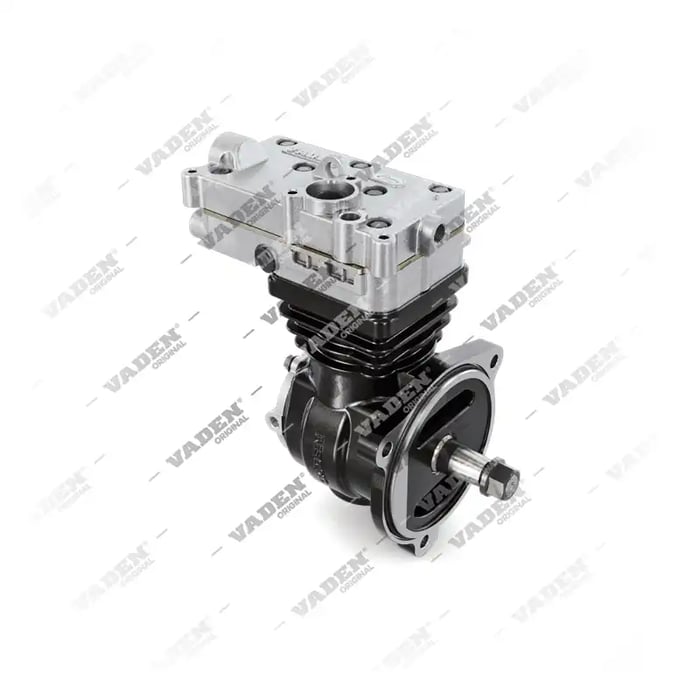
Need the part, not just the answer?
OE-grade air brake compressors and repair kits, manufactured and tested to commercial-vehicle standards.
Shop VADEN partsPublished by VADEN Original. Product links point to the manufacturer’s official catalogue. Specifications are general — always confirm figures against your vehicle’s service manual.