 airbrakecompressor
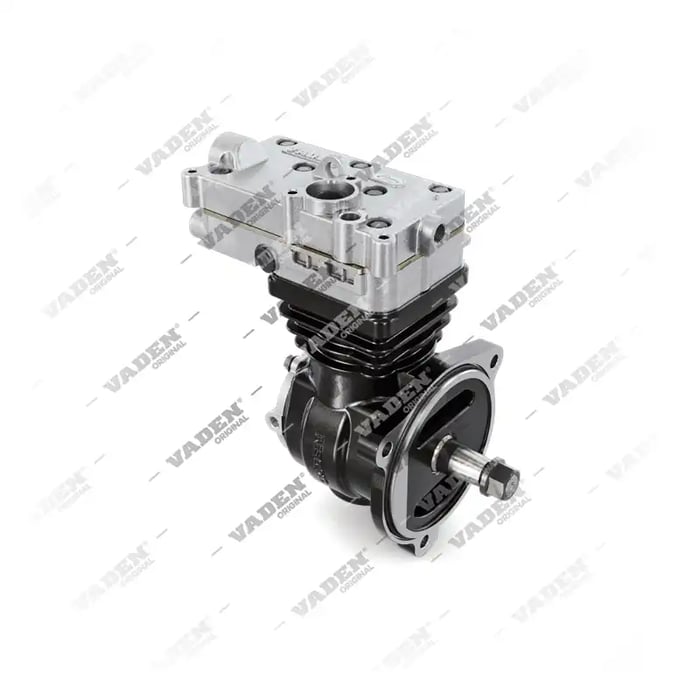
The Volvo D13 and Mack MP8 share a common engine architecture, and in most model years they carry the same physical air compressor: a gear-driven, water-cooled reciprocating unit mounted at the rear gear train. What differs is the paperwork. Volvo and Mack publish separate part numbers for what is often the identical casting, and within each brand the number splits again by cylinder count, drive gear supply, port orientation and governor arrangement. Order against the engine serial number and the number stamped on the compressor body — not against the engine model name.
One platform, two part number systems
Volvo Group builds the D11/D13/D16 and the Mack MP7/MP8/MP10 on the same core design, with MP-series engines carrying Mack-specific calibration, packaging and accessory content. For the air brake supply side this matters in one practical way: a compressor pulled from an MP8 will very often interchange physically with a D13 of the same emissions generation, but the two brands catalogue it under different numbers, and a parts counter searching one system will not surface the other.
The compressors themselves come from the usual heavy-vehicle suppliers — Knorr-Bremse and its Bendix operation, and Wabco (now ZF) — under OE numbers. That means a single unit can legitimately appear under a Volvo number, a Mack number, and the compressor manufacturer's own number. All three describe the same hardware. Problems start when a buyer cross-references from one system to the other and lands on a variant that differs in a detail the catalogue did not flag.
How the compressor is driven and cooled
On this platform the compressor sits at the flywheel end of the engine and is driven by the rear gear train. There is no belt, no pulley and no tensioner to inspect, which removes a common wear path but adds two others: gear backlash and the sealing of the mounting flange. Lubricating oil is fed under engine pressure through that flange and returns to the crankcase, and coolant is routed to the cylinder head to carry away compression heat. A flange gasket that is the wrong thickness, or an O-ring left out of a port, will show up as an external oil or coolant leak within minutes of first start.
Because the unit is gear-driven, it turns whenever the engine turns, and the unloader mechanism — not an on/off clutch — is what stops it pumping once the governor cuts out. If you want the broader comparison, see gear-driven versus belt-driven compressors. Note also that emissions generation and whether the engine is a turbocompound build can change rear-of-engine packaging, so verify by serial rather than by model badge.
The splits buyers get wrong
These are the five points where two "D13 air compressor" listings stop being the same part.
| Split point | What changes | Consequence of getting it wrong |
|---|---|---|
| Cylinder count and displacement | Single-cylinder covers most linehaul specs; larger single or twin-cylinder units appear on vocational and high accessory-air chassis | Undersized unit runs a long duty cycle, overheats and passes oil; oversized unit cycles hard and loads the gear train |
| Drive gear included or not | Some listings ship bare, some with the gear pressed on | Truck down waiting for a gear, or a paid-for gear that duplicates the one you already have |
| Discharge port orientation | Rear-facing versus side-facing discharge on the cylinder head | Discharge line will not route without strain, fittings loaded in bending |
| Coolant and unloader port configuration | Head porting differs between variants of the same casting family | Lines will not land; blanked or open ports that should be the opposite |
| Governor location | Governor mounted on the compressor on some builds, remote on the air dryer or frame on others; some later builds use an ECM-commanded unloading strategy | Missing mounting pad, or a governor supplied that has nowhere to go |
Identifying what is actually on the engine
- Record the engine serial number from the data plate on the block — this is the primary key for both Volvo and Mack parts systems.
- Clean and read the number cast or stamped into the compressor body and the tag on the cylinder head. Photograph both before removal.
- Count the cylinders and note the discharge port direction and how many coolant and air ports are in use.
- Check whether the governor sits on the compressor head or is remote-mounted, and whether it is plumbed or wired.
- Cross-check the resulting number against the compressor manufacturer's own reference, then against the opposite brand's system. Our walkthrough on verifying compressor fitment before buying covers the sequence, and reading an air compressor part number explains what the digits encode.
Symptoms that point at the compressor
- Slow build. A common inspection benchmark for a dual air system is a rise from roughly 85 to 100 psi within about 45 seconds at fast idle; a unit that misses it badly is either worn, unloading when it should be pumping, or feeding a system with leaks.
- Oil downstream. Oil at the air dryer purge, in the wet reservoir, or fouling valves indicates worn rings or a restricted crankcase return.
- Knock under load. Gear-driven units transmit noise into the block; a distinct knock that follows engine speed and changes when the system reaches cut-out warrants inspection of the compressor and its drive gear.
- Coolant loss with no external leak. A failed head gasket on a water-cooled compressor can push coolant into the air side.
- Never cutting out. Before condemning the compressor, confirm the governor and the unloader circuit, since a governor fault makes a healthy compressor run continuously.
Replacement notes
Drain the system and cage the spring brake chambers before opening anything. As a driven accessory the compressor does not need valve timing alignment, but the gear must mesh with correct backlash and the mounting flange must seal both the oil feed and the coolant passages — dry-fit the gasket and confirm every port lines up before torquing. Replace the discharge line rather than reusing it; carbon build-up in that line is a direct cause of repeat failures and of the replacement unit running hot.
If the old unit passed oil, treat the downstream side as contaminated: change the air dryer cartridge, drain and inspect the reservoirs, and check the valves nearest the supply for oil fouling. Refill and bleed coolant properly, then run the engine up and confirm the governor cuts out and cuts in within the normal band before the truck leaves the shop.
Pressure reference
| Condition | Typical range |
|---|---|
| Governor cut-out | 120-135 psi |
| Governor cut-in | 100-110 psi |
| Fully charged system, running | about 120 psi |
| Low-air warning activates | around 60 psi |
| Spring brakes apply automatically | 20-45 psi |
Always confirm the values published by the vehicle manufacturer for the chassis in front of you; the ranges above are the normal operating envelope for a heavy-vehicle air brake system, not a substitute for the service manual.
Need the part, not just the answer?
OE-grade air brake compressors and repair kits, manufactured and tested to commercial-vehicle standards.
Shop VADEN partsPublished by VADEN Original. Product links point to the manufacturer’s official catalogue. Specifications are general — always confirm figures against your vehicle’s service manual.