 airbrakecompressor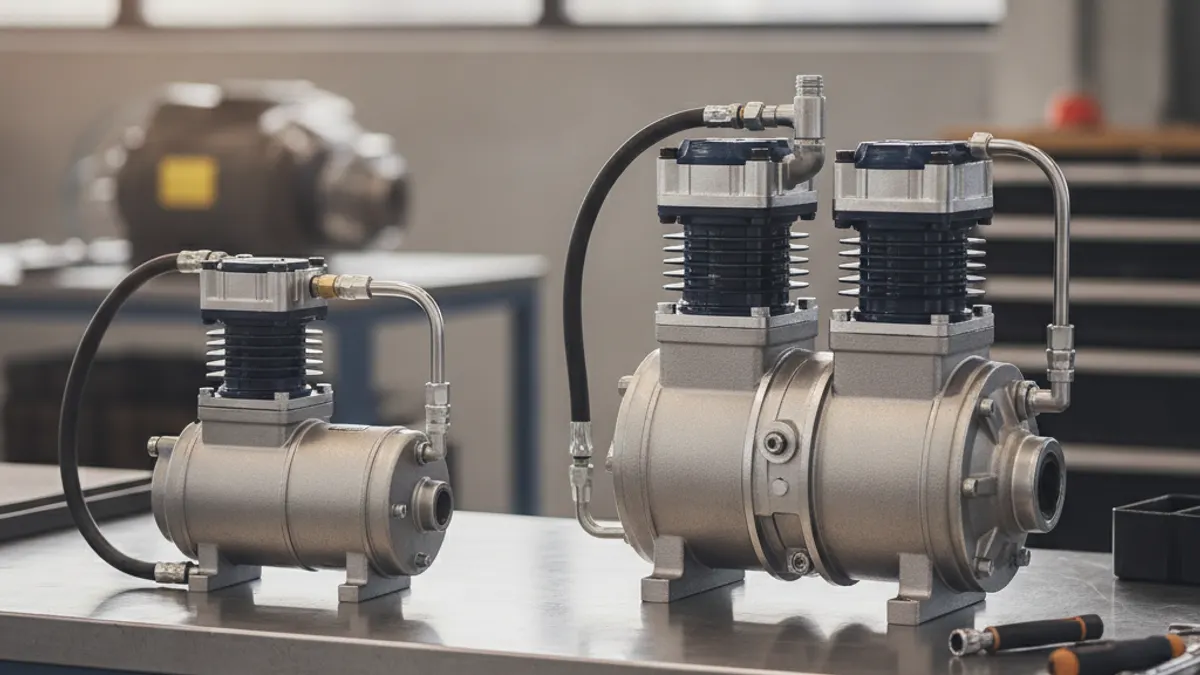
A single-cylinder air compressor has one piston; a twin-cylinder has two, so for the same bore, stroke and drive speed it pumps roughly double the air per revolution. That extra displacement buys you faster reservoir charging and a lower duty cycle — it does not raise system pressure. Both types are controlled by the same governor, so a fully charged system still sits near 120 psi, with cut-out typically between 120 and 135 psi and cut-in around 100 to 110 psi. Pick a single-cylinder unit when air demand is light and the reservoir volume is modest; pick a twin-cylinder when the vehicle carries large tanks, air suspension, or accessories that bleed air all day.
What actually changes when you add a second cylinder
Truck and bus compressors are pneumatic reciprocating pumps driven by the engine, either through a gear off the timing case or by belt, and they are lubricated and cooled by the engine's own oil and coolant circuits. The air brake compressor runs continuously whenever the engine turns; the governor only decides whether it is pumping into the tanks (loaded) or idling through the unloader (unloaded).
Adding a cylinder changes three things. First, displacement per revolution roughly doubles, so the tanks fill quicker and the compressor spends less of each hour loaded. Second, the crank sees two power strokes per revolution instead of one, which smooths torque pulses on the drive gear but increases the load the engine has to carry while charging. Third, the head and crankcase get physically larger and heavier, which matters when you are fitting a compressor into a tight engine bay or onto a bracket that was designed for a smaller unit.
What does not change is pressure capability. Cylinder count sets flow, not ceiling. If a truck will not build air past a certain point, the fault is almost always a leak, a stuck unloader, a restricted discharge line or a governor problem — not the number of pistons.
Output and duty cycle: the numbers that matter
Compressors are rated by displacement, usually in CFM at a stated compressor speed. Published figures vary widely by model and drive ratio, so treat the following as typical bands rather than fixed values and confirm against the manufacturer's data sheet for the exact part number.
| Characteristic | Single-cylinder | Twin-cylinder |
|---|---|---|
| Typical displacement band | Roughly 7-14 CFM at rated speed | Roughly 12-35 CFM at rated speed |
| Charging time for a given tank volume | Longer | About half, all else equal |
| Loaded time on a heavy-demand vehicle | High, risk of exceeding recommended duty cycle | Lower, more headroom |
| Discharge temperature under sustained load | Rises faster when undersized | Better controlled at the same demand |
| Weight, package size, engine load | Lower | Higher |
| Purchase and rebuild cost | Lower | Higher (two liners, two piston sets) |
Duty cycle is the number most people ignore and the one that kills compressors. A common industry guideline is that the compressor should spend no more than about a quarter of its operating time pumping into the tanks; beyond that, heat and oil carryover climb. If you know the loaded percentage is high, you have either an undersized unit or a demand problem, and it is worth reading up on why an air compressor runs constantly before you throw a bigger pump at it.
There is also a legal floor in North America. FMVSS 121 requires the compressor to raise supply and service reservoir pressure from roughly 85 to 100 psi within 25 seconds at maximum governed engine speed for the vehicle's rated reservoir capacity. Any replacement you fit has to meet that with the tanks the vehicle actually carries. For the arithmetic behind matching displacement to tank volume, see the CFM and displacement buying guide.
Which one belongs on your vehicle
| Vehicle / duty | Usual choice | Why |
|---|---|---|
| Rigid truck, straight highway work, no accessories | Single-cylinder | Small reservoir volume, few applications per hour |
| Tractor-trailer with air suspension | Twin-cylinder | Trailer volume plus levelling valve consumption |
| City bus or coach | Twin-cylinder | Doors, kneeling and constant stop-start braking |
| Refuse, mixer, tipper with air-shifted PTO | Twin-cylinder | High cycle count at low engine speed |
| Vehicle spending long periods at idle | Twin-cylinder | Compressor speed is low, so displacement per minute is low |
The idle case catches people out. Output is proportional to compressor rpm, so a unit that is comfortable at cruise can fall behind on a refuse route where the engine spends most of the shift near idle while the body and brakes are cycling.
Cooling, oil carryover and dryer life
An overworked compressor is an oil pump as much as an air pump. When a single-cylinder unit is forced to run loaded for long stretches, head temperature climbs, oil in the discharge port carbonises, and vapour that would normally condense downstream instead loads the air dryer desiccant. The symptoms show up far from the compressor: sludge in the tanks, a dryer that purges wet, valves that stick, and eventually contamination through the whole pneumatic circuit.
A correctly sized twin-cylinder unit spends more of its life unloaded and runs cooler. That said, a twin is not immune — a restricted discharge line, an undersized coolant feed or a worn unloader will overheat either type. If oil is appearing downstream, diagnose the discharge path and duty cycle before condemning the compressor.
How to spec the replacement
- Start from the OE part number and engine application. Cylinder count is a consequence of the spec, not the starting point.
- Confirm displacement against the vehicle's total reservoir volume and the 85-to-100 psi in 25 seconds requirement where it applies.
- Check the drive: gear-driven versus belt-driven, gear tooth count, spline or flange type, and rotation.
- Check mounting: flange pattern, stud spacing, and clearance for the larger crankcase if you are moving from single to twin.
- Check the unloader and governor arrangement, plus coolant and oil port positions and thread sizes.
- Match discharge line size and routing, and replace the air dryer cartridge at the same time if the old unit was passing oil.
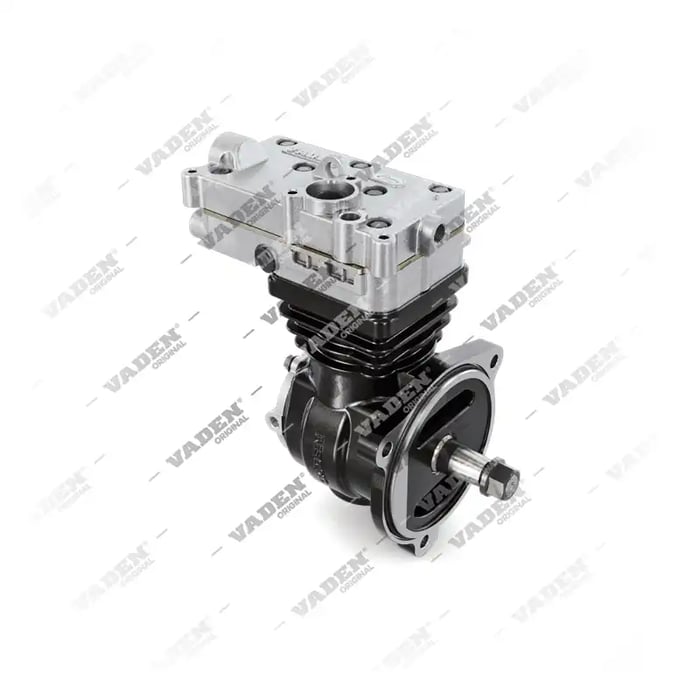
Both configurations are made to OE standards for the common heavy-vehicle applications; VADEN's range of single and twin-cylinder air brake compressors is listed by OE cross-reference so you can verify displacement, drive and flange before ordering.
Mistakes that lead to the wrong choice
- Fitting a bigger compressor to cure slow build-up. If the original unit met spec when new, the fault is usually leakage, a stuck unloader or a governor out of adjustment.
- Assuming twin means higher pressure. Cut-out is set by the governor, not the pump.
- Ignoring engine load. A larger compressor draws more power while charging; on a marginal drive gear or belt, that shows up as wear.
- Downsizing to save money. A cheaper single-cylinder unit on a bus or vocational chassis will run past its duty cycle and take the dryer and valves with it.
Rule of thumb: if the low-air warning around 60 psi ever appears in normal service, or the system struggles to recover after repeated brake applications, you have a demand-versus-supply problem. Fix the leaks first, then reconsider displacement.
Need the part, not just the answer?
OE-grade air brake compressors and repair kits, manufactured and tested to commercial-vehicle standards.
Shop VADEN partsPublished by VADEN Original. Product links point to the manufacturer’s official catalogue. Specifications are general — always confirm figures against your vehicle’s service manual.