 airbrakecompressor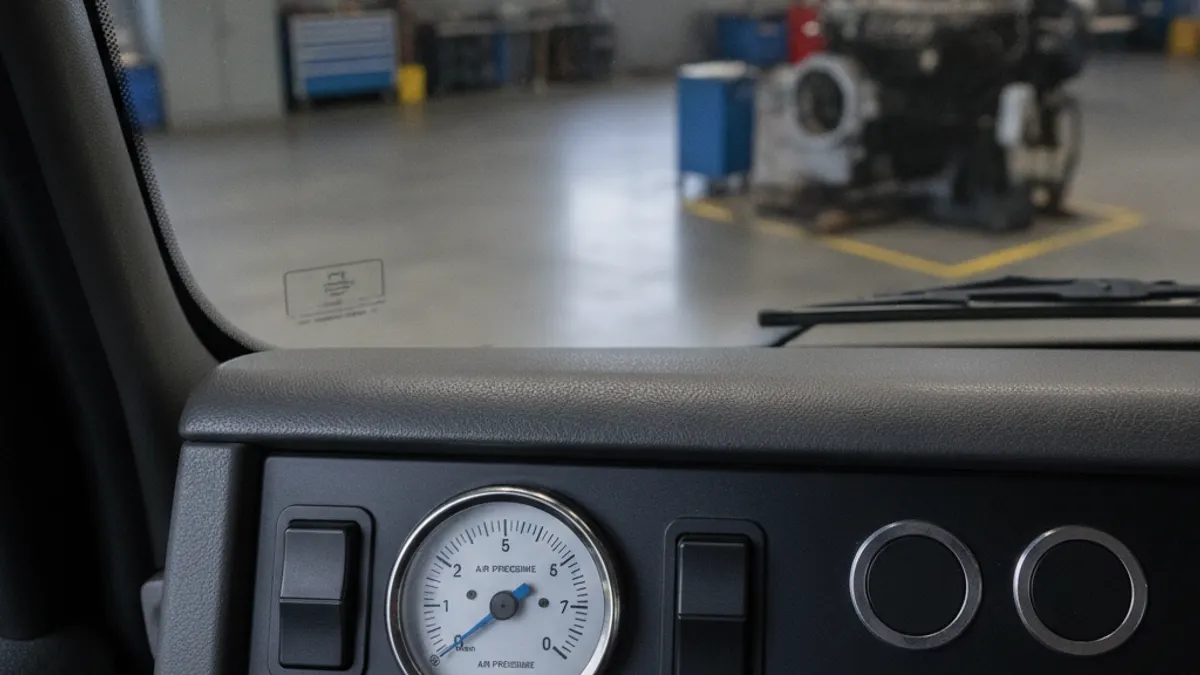
A dual air brake system is a heavy-vehicle braking setup that divides the service brakes into two completely separate air circuits — a primary circuit and a secondary circuit. Each circuit has its own reservoir (tank), its own supply lines, and its own set of valves. Both are charged by the same air compressor, but downstream of the supply they are isolated from one another. The point is simple redundancy: if one circuit springs a leak or a line lets go, the other circuit still has air and still stops the truck.
Nearly every truck, tractor, and bus built for U.S. roads since the mid-1970s uses this split design. A single-circuit air system was a single point of failure — one broken line and you had no service brakes. The dual layout removes that risk. It is the reason a properly maintained air brake vehicle can lose an entire circuit and still be brought to a controlled stop.
How the two circuits are split
The compressor charges a supply (or "wet") tank, and from there air is routed into two independent service reservoirs. A dual-circuit foot valve (the treadle) meters air to both circuits at once when you press the brake pedal. On most straight trucks and tractors the split follows the axles:
| Feature | Primary circuit | Secondary circuit |
|---|---|---|
| Typically controls | Rear / drive axle service brakes | Front / steer axle service brakes |
| Own reservoir | Yes | Yes |
| Own gauge needle | Yes | Yes |
| On a tractor-trailer | Usually also feeds the trailer supply | Backs up braking if primary is lost |
Exact plumbing varies by manufacturer and vehicle — some designs feed the trailer from the primary side, others cross-feed differently — but the principle is constant: two isolated circuits, one pedal, one air source. Both circuits sit downstream of the compressor and its charging controls, so the whole system depends on healthy upstream components. If you want to understand how air gets from the compressor to these tanks in the first place, see how air brake systems work.
Why the redundancy matters
Air lines chafe, fittings loosen, and hoses fail — usually one at a time. With a dual system, a failure is contained to a single circuit. You lose roughly half your service braking, but you keep the other half. Instead of a total loss of brakes at highway speed, you get a degraded but drivable vehicle, plus a loud warning telling you to pull over. That difference is what keeps a mechanical fault from becoming a crash.
What happens when one circuit fails
Behavior depends on which circuit is lost, but the pattern is predictable:
- Lose the primary circuit: rear service brakes drop out. You still stop on the front (secondary) brakes, but stopping distance grows and you must push the pedal harder. The low-air warning trips.
- Lose the secondary circuit: front service brakes drop out. The rear service brakes still work. Again the warning activates.
- Keep bleeding air down: if you ignore the warning and pressure keeps falling, the spring (parking) brakes apply automatically — typically somewhere around 20-45 psi — and bring the vehicle to a stop whether you want it or not.
The safe response to any air loss is the same: get off the road and stop while you still have air, then find and fix the leak. A vehicle that keeps losing pressure is telling you something specific — start with what a fully charged air brake system should read so you know what "normal" looks like before you diagnose.
Dashboard gauges and warnings
On a dual system the dash shows both circuits. That is usually either two separate needles or a single dual gauge with two pointers — one for primary, one for secondary. Reading them side by side is the whole point: if one needle sags while the other holds steady, you have isolated the failing circuit before you even leave the yard.
| Condition | Approx. pressure | What it means |
|---|---|---|
| System fully charged | ~120 psi | Normal running range, both needles together |
| Governor cut-out | ~120-135 psi | Compressor stops loading the system |
| Governor cut-in | ~100-110 psi | Compressor resumes building air |
| Low-air warning light & buzzer | at or below ~60 psi | A circuit is low — stop safely |
| Spring (parking) brakes apply | ~20-45 psi | Automatic emergency stop as air runs out |
Note that a dual system does not always warn you the instant a circuit fails, if the failing circuit still holds some pressure. That is exactly why scanning both needles during your walk-around and while driving matters.
Why it's on the CDL exam
Because the dual layout is a safety feature, the CDL air brake pre-trip inspection is built around proving it works. On a vehicle with dual air, examiners look for the two-circuit checks specifically:
- Build pressure to governor cut-out, then confirm the governor cuts the compressor out and cuts back in within range.
- With the engine off and the brakes released, check the static leak-down rate — commonly a maximum of about 3 psi in one minute for a single vehicle and 4 psi for a combination.
- Apply and hold the brake and check applied leakage — roughly 4 psi per minute single, 6 psi per minute combination.
- Fan the pressure down and confirm the low-air warning comes on at or before ~60 psi.
- Keep fanning and confirm the spring brakes apply automatically in the ~20-45 psi range.
Those numbers are standard test values, not vehicle-specific specs. For the full walk-through, our CDL air brake test guide breaks each step down.
Keeping both circuits healthy
The redundancy only helps if the hardware feeding it is sound. Two circuits share one compressor, one governor, and one air dryer, so an upstream fault — a compressor that can't build pressure, a leaking governor, or a saturated dryer passing water and oil downstream — degrades both circuits at once. That is why compressor and valve condition sits at the top of any air brake maintenance plan. When those components wear out, fit OE-grade parts from a proven air brake system components range rather than bargain replacements; the whole safety case for a dual system rests on the parts that charge it working exactly as designed. Manufacturing pedigree is a fair proxy for that reliability — VADEN, for example, reached the milestone of its millionth air brake compressor, a volume that only holds up when every unit is built to OE tolerances.
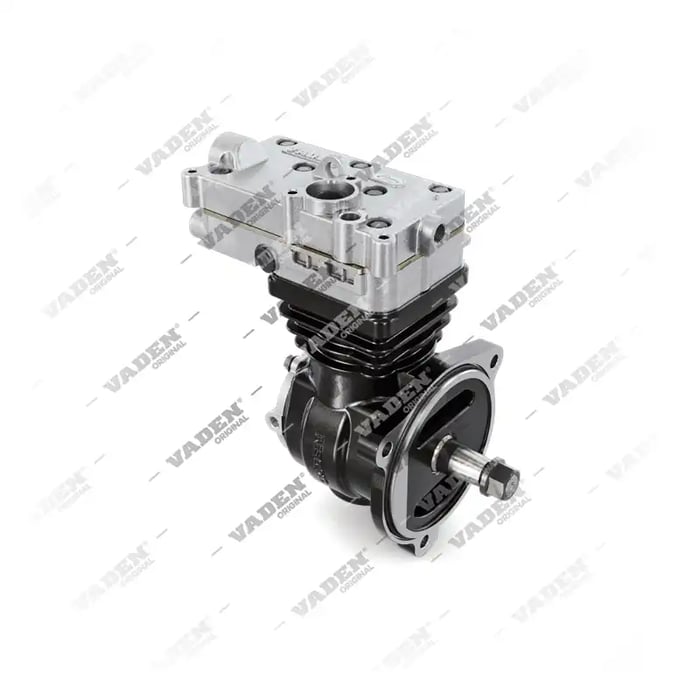
Need the part, not just the answer?
OE-grade air brake compressors and repair kits, manufactured and tested to commercial-vehicle standards.
Shop VADEN partsPublished by VADEN Original. Product links point to the manufacturer’s official catalogue. Specifications are general — always confirm figures against your vehicle’s service manual.