 airbrakecompressor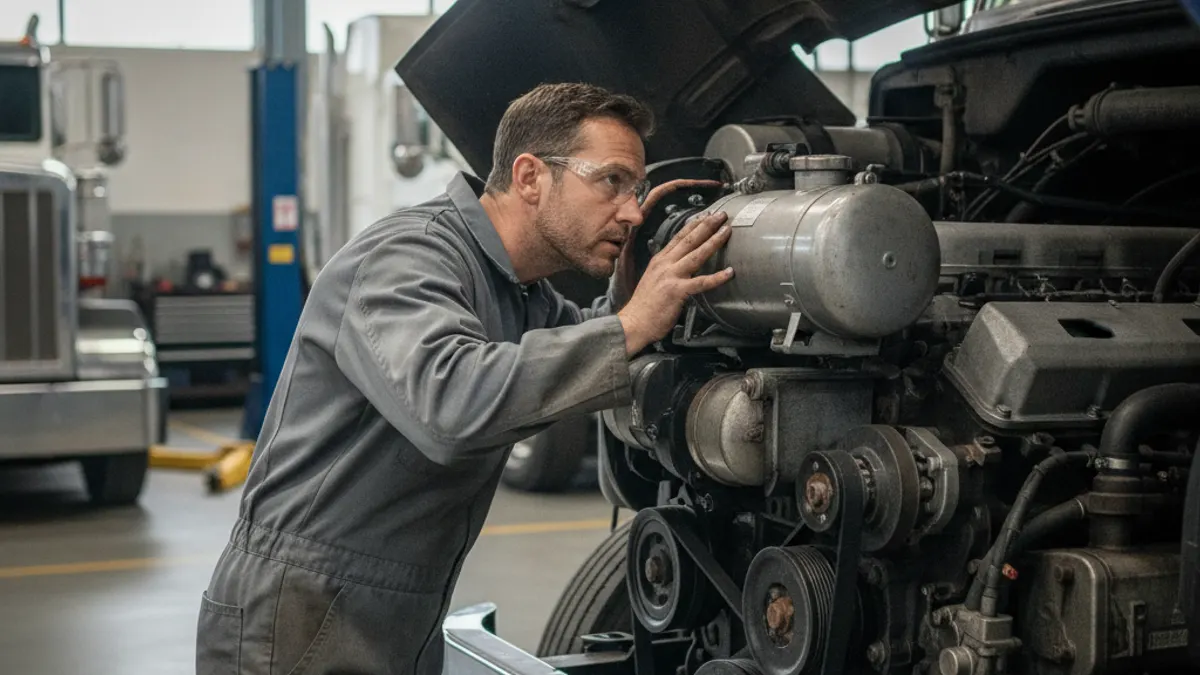
A knocking or rattling noise from a truck's air brake compressor usually points to worn internal parts — most commonly the connecting-rod bearing or crankshaft main bearings — or to something loose on the outside, such as the mounting bracket or drive gear. As a rule of thumb, a deep metallic knock that speeds up with engine RPM and gets louder as the compressor loads (builds pressure toward governor cut-out) signals internal wear, and the compressor should be replaced before it fails outright. A looser, higher-pitched rattle is often external and much cheaper to fix. This guide helps you tell them apart.
Normal compressor noise you can ignore
Air brake compressors are engine-driven pumps, so they are never silent. Before chasing a fault, rule out the sounds a healthy unit makes:
- A light, even tapping in time with engine speed. Reed or disc valves seating on every stroke. It is present on healthy units and does not change character under load.
- A sharp pop or hiss at the top of the charge cycle. When system pressure reaches cut-out, typically 120-135 psi, the governor unloads the compressor and the air dryer purges. It is loud on some trucks and completely normal.
- A rise in working noise between cut-in and cut-out. The compressor loads when pressure falls to cut-in, roughly 100-110 psi, and pumps back up to a fully charged system around 120 psi. It genuinely works harder there and sounds like it.
- Belt squeal or a whine that changes only with throttle. That points at the belt, tensioner, or an accessory, not the compressor internals.
A genuine failure knock is a different sound: deeper and heavier, metallic rather than tinny, and it keeps time with compressor speed rather than with the exhaust note — which is also how you separate it from an engine knock.
What the noise is telling you
Air brake compressors are small piston pumps driven by the engine — either gear-driven off the timing gears or belt-driven. Like any reciprocating pump, they wear at the bearings, valves, rings, and drive connection. The character of the noise, and when it happens, narrows the cause quickly:
- Deep knock, load-related: loudest while the compressor is pumping (between governor cut-in around 100-110 psi and cut-out around 120-135 psi) and it fades once the system is charged and the compressor unloads. This is the classic worn-bearing signature.
- Rattle that changes with engine vibration: present at idle, often worse on a rough surface, and it doesn't clearly track pumping load. Usually a loose mount or drive component.
- Ticking or tapping with weak air: a lighter, faster sound paired with slow pressure build or the compressor running almost constantly. Points to the valve plate.
- Cold knock that quiets when warm: piston slap from a worn piston, wrist pin, or cylinder bore — the piston rocks in the bore until heat expands it.
Common causes of a knocking air compressor
| Noise | Likely cause | Typical fix |
|---|---|---|
| Deep metallic knock, louder under load, tracks RPM | Worn connecting-rod bearing | Replace compressor (or full rebuild) |
| Low knock or rumble, present most of the time | Worn crankshaft main bearings | Replace compressor |
| Sharp knock or "pinging," hot discharge line, oil use | Carbon buildup in head/discharge from oil passing worn rings | Replace or rebuild; fix oil source |
| Rattle at idle, changes with engine vibration | Loose mounting bolts or bracket | Torque or replace bracket hardware |
| Rattle/clatter, worse at idle, gear-driven unit | Worn drive gear, loose gear nut, or bad coupling | Replace drive gear/coupling |
| Rapid tick or tap, slow air build, compressor runs constantly | Failing discharge or inlet (reed/plate) valves | Valve/repair kit or replace |
| Knock when cold that fades as it warms | Piston slap — worn piston, wrist pin, or cylinder bore | Rebuild or replace |
| Knock that arrives minutes after a cold start and never settles | Bearing oil starvation — low oil pressure, restricted feed, or blocked return | Fix the oil supply before condemning the unit |
That last cause is the one most often missed, because it is not a wear item at all. Low engine oil pressure, a restricted feed line, or a blocked return starves the compressor's bearings and produces a knock that arrives shortly after a cold start and never quiets down; a new compressor fed the same way will knock too. The mounting row hides a second false alarm worth clearing early: a discharge line resting against a frame rail hammers exactly like an internal knock, so check line clearance as well as bolt torque before anything comes off.
How to diagnose it, step by step
- Confirm the source. Chock the wheels and set the parking brakes. With the engine idling, use a mechanic's stethoscope or a long screwdriver held to your ear on the compressor body, then the head, then the drive housing, and compare each against the mounting bracket and against a known-good point on the engine block. A knock loudest on the compressor itself is internal; one loudest at the bracket is a mount issue; one no louder there than on the block is the engine, not the compressor.
- Listen through a pump-up cycle. Drain a tank to drop pressure so the governor calls the compressor to load. If the knock clearly intensifies as pressure climbs toward cut-out — and softens the moment the governor unloads — that load-dependent knock strongly suggests rod/main bearing wear.
- Check the mount and drive. With the engine off, try to move the compressor by hand. Any rock or play at the bracket, or gear lash you can feel on a gear-driven unit, explains a rattle. Inspect for cracked brackets, loose bolts, and lines touching the frame.
- Inspect the discharge line temperature and oil. An abnormally hot discharge line and oil-fouled tanks point to carbon and oil carryover. If you can access the compressor oil or the crankcase drain, look for metallic glitter — a serious sign of bearing breakup. On engine-lubricated units the same check applies to the engine oil, so pull a sample or cut the filter open if you need confirmation.
- Watch pressure build time. If it takes far longer than usual to go from cut-in to cut-out and you hear ticking, the valves are the likely culprit rather than the bearings.
If the noise is accompanied by symptoms like slow pressure build or oil in the tanks, cross-check against the full list of failing air brake compressor symptoms to confirm the diagnosis before you spend money.
Depressurize before you open anything. Drain the reservoirs and bleed system pressure before disconnecting any air line — a charged air brake system stores enough energy to injure, and a line can whip when a fitting lets go.
Which noises mean replace now
Not every noise is an emergency, but a few clearly are. Stop relying on the compressor and get it replaced when you have any of these:
- A load-related knock with metal in the oil. The rod or main bearing is coming apart. On engine-lubricated compressors those bearings share the engine's oil supply, so the debris does not stay inside the compressor — it circulates through the engine. Continued running risks the compressor seizing or shedding debris into the air system or, on gear-driven units, into the engine timing gears.
- Knock plus heavy oil consumption and an overheating discharge line. This combination lets carbon and oil migrate downstream, which can foul the air dryer and valves. If your compressor is also passing oil, see why an air compressor pumps oil for the underlying causes.
- Any grinding or rising-pitch metallic sound. That is friction from failed bearings; seizure can follow with little warning.
A steady rattle that turns out to be a loose bracket bolt or a worn drive gear is not an internal failure — repair the mount or drive and re-evaluate. But do not keep driving on a genuine internal knock hoping it settles; it won't.
Repair or replace?
Valve problems are often the one knock-adjacent fault worth repairing rather than replacing. Worn reed or plate valves that cause ticking and slow air build can frequently be restored with OE-grade compressor repair kits that include fresh valve plates, gaskets, and seals. Bearing, crankshaft, and cylinder-bore wear is a different story — by the time a compressor knocks under load, a new unit is usually the more reliable and cost-effective choice than chasing a rebuild on high-mileage internals. Our page on rebuild versus replace covers the cost side in detail.
When you do replace it, fit a genuine OE-grade unit matched to your engine and duty cycle. Match it by OE number and by engine and mounting configuration rather than by displacement alone: cross-reference the original Bendix, Wabco, Knorr-Bremse, or truck OEM part number, and confirm drive type, port positions, cylinder count, and the unloader and coolant arrangement before ordering. VADEN's range of air brake compressors covers single- and twin-cylinder units built to original-equipment tolerances, which keeps pressure build times and oil control where they should be. For the full swap procedure and torque and break-in notes, see the air brake compressor replacement guide.
Preventing the next one
Most compressor bottom ends die from contamination, heat, and excessive duty cycle rather than from mileage alone. Drain the reservoirs on schedule, replace the air dryer cartridge at the recommended interval, keep the intake air filter clean, and fix air leaks promptly so the compressor is not loaded most of the time. Hold engine oil change intervals, and re-torque the compressor mounting hardware after any removal. A compressor that cycles normally between cut-in and cut-out behind a dry, leak-free system will outlast one running almost constantly to feed a leaking trailer line.
Safety note
The air compressor is the source of every brake application on a heavy vehicle, so treat a suspicious noise as a safety item, not a nuisance. If the compressor fails to keep up, the low-air warning activates around 60 psi and the spring (parking) brakes will apply automatically as pressure falls into roughly the 20-45 psi range — potentially while you are moving. A gear-driven compressor that seizes can also damage the engine's timing gears. If you hear a load-related knock, keep the system fully charged, avoid long trips, and get it inspected promptly. Regular attention to the compressor and air dryer is the cheapest way to avoid a roadside failure.
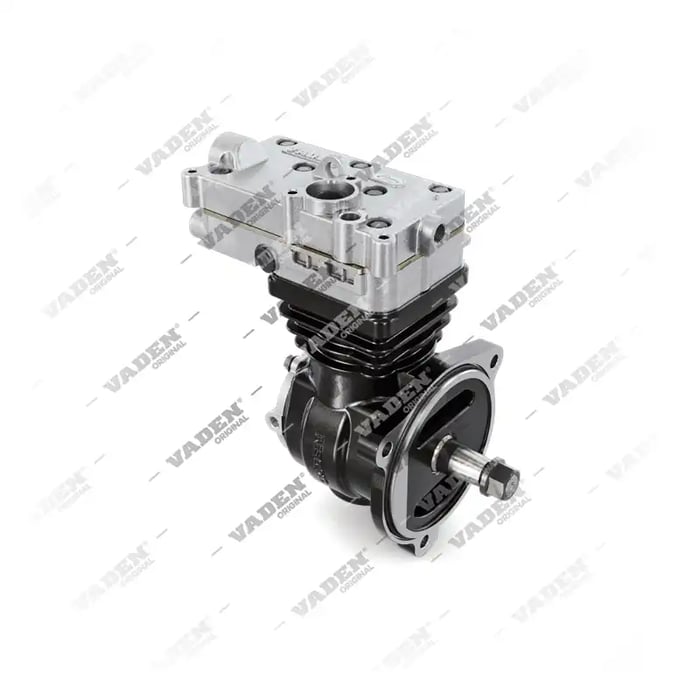
Need the part, not just the answer?
OE-grade air brake compressors and repair kits, manufactured and tested to commercial-vehicle standards.
Shop VADEN partsPublished by VADEN Original. Product links point to the manufacturer’s official catalogue. Specifications are general — always confirm figures against your vehicle’s service manual.