 airbrakecompressor
On a belt-driven air brake compressor, the pulley, hub and clutch fail long before the pump itself does. Noise, belt chirp and short belt life almost always trace back to one of four things: pulley misalignment, wrong belt tension, a failed bearing in the hub or clutch rotor, or a loose taper and key joint at the compressor crankshaft nose. Work through those four before you condemn the compressor, because replacing a pump that was never the fault will not stop the belts from burning.
What the drive assembly contains
Only belt-driven installations have this hardware. A gear-driven compressor takes its drive off the engine timing gear train and has no pulley at all, so the first step is knowing which one is on the engine in front of you. If you are unsure, compare the two arrangements in the guide to gear-driven versus belt-driven compressors.
- Driving pulley on the crankshaft damper or accessory drive.
- Compressor pulley and hub, mounted to the compressor crankshaft nose either on a straight shaft with a key and retaining nut, or on a machined taper with a key and a large nut that draws the hub up.
- Belt: a single V-belt, a matched V-belt set, or a serpentine (poly-V) belt shared with other accessories.
- Tensioner or idler: an automatic spring tensioner, or a manual adjuster on a slotted bracket.
- Clutch, where fitted: an electromagnetic coil, a rotor riding on a bearing, and an armature plate keyed to the compressor shaft. Common on bus, coach and vocational installations where accessory air demand is high.
Why belt-driven compressors are hard on belts
The load is not constant. The compressor pumps until the governor reaches cut-out, roughly 120 to 135 psi, then the governor unloads it and the torque demand collapses almost to nothing. It stays unloaded until reservoir pressure falls to cut-in, roughly 100 to 110 psi, and then the full load comes back on instantly. A system sitting fully charged near 120 psi is doing this several times an hour, and each cycle is a shock load on the belt and the hub joint.
Single-cylinder compressors are worse than twins, because one compression stroke per revolution produces a coarse torque pulse rather than a smooth draw. Anything that raises duty cycle — a leak, air seats, air suspension dumping, on-board tire inflation — multiplies the number of those cycles and shortens belt life in direct proportion.
Reading the noise
| What you hear or see | Usual cause | Check |
|---|---|---|
| Sharp chirp at idle, rising with engine speed | Pulley misalignment, or a dry idler or tensioner bearing | Straightedge across the machined pulley faces; spin idler and tensioner by hand with the belt off |
| Squeal that appears only while the compressor is loaded | Belt slip: low tension, glazed belt, oil or coolant contamination, worn pulley grooves | Belt tension gauge against the OE figure; look for shine on the belt sidewalls and in the grooves |
| Continuous growl, still present when the shaft is turned with the belt removed | Compressor crankshaft bearing or clutch rotor bearing | Turn the shaft by hand and feel for roughness, drag and radial play |
| Visible wobble or runout of the pulley face | Bent hub, loose retaining nut, worn taper or elongated keyway | Watch the pulley face at idle; recheck nut torque and inspect the key and keyway |
| Chatter or slip from the clutch under load | Worn friction faces, excessive air gap, low coil voltage or a poor ground | Feeler gauge on the air gap, voltage at the connector, coil resistance against spec |
| Rhythmic metallic knock that changes with load, not with belt tension | Internal, not the drive | See compressor knocking noise |
Reading the belt
The old belt is evidence. Take it off and look at it before fitting anything new.
- Wear on one sidewall only: misalignment. Fix the alignment or the new belt goes the same way.
- Glazed, hard, shiny sidewalls: slip. Tension, contamination or worn grooves that no longer grip.
- Belt rolled out of the groove or flipped: severe misalignment, a damaged groove, or worn tensioner bushings letting the pulley skew under load.
- Swollen, soft, oily belt: contamination. Find the source; a wet compressor front seal is a common one and tells you the pump needs attention too.
- Cracked ribs with the sidewalls still square: normal age and heat. Replace on schedule, no further diagnosis needed.
Checking a compressor clutch
A clutch exists to disconnect the compressor completely instead of letting it spin unloaded, cutting parasitic drag and heat. It is switched electrically, usually from the same governor signal that would otherwise unload the pump. Two failure directions matter, and they look nothing alike.
A clutch that fails disengaged gives you no air build at all, with a silent compressor and a belt that shows no distress. Check for voltage and a clean ground at the connector when the clutch should be pulled in, then measure coil resistance; an open or shorted coil will not hold the armature. A clutch that fails engaged, or that slips, is the noisier problem: the armature and rotor faces blue and groove, duty cycle climbs, and the compressor runs hotter and carries more oil forward. Measure the air gap with a feeler gauge and set it with shims to the manufacturer's figure, typically a few hundredths of an inch, around 0.3 to 0.8 mm on common designs. Never guess at it; use the figure the compressor or clutch manufacturer publishes for that part number.
Fitting a pulley or hub correctly
- Chock the wheels and drain the reservoirs before working on the drive. Remember that spring brakes apply as pressure falls through roughly 20 to 45 psi, so the vehicle will set its own parking brakes as the tanks empty; chock it anyway.
- Never drive a hub on with a hammer. Pull it off with a proper puller, and where the design calls for it, draw it up with the retaining nut or the specified installation tool.
- Clean the taper and bore dry. Do not oil or anti-seize a taper joint unless the manual says so; a lubricated taper over-seats at the same torque and cracks hubs.
- Always fit a new key, and inspect the keyway. A rounded or hammered keyway means the joint has been running loose, and the shaft nose may not be reusable.
- Torque the retaining nut to the OE figure with a calibrated wrench and fit a new tab washer or lock where one is used.
- Align the pulleys with a straightedge or a laser alignment tool across the machined faces before tensioning anything.
- Set tension with a gauge to spec, or confirm an automatic tensioner sits inside its range marks, then run the engine briefly and recheck. New belts relax on the first heat cycle.
When the drive is fine and the compressor is not
If the shaft turns rough or has radial play with the belt removed, or the drive end is wet with oil, the pump is the problem and no amount of alignment work will save it. Equally, if the belt is correctly tensioned and aligned and the system still charges slowly, the fault is downstream of the drive: governor, unloader, a restricted discharge line or leakage. Work that path through the guide to a compressor not building pressure rather than fitting another belt.
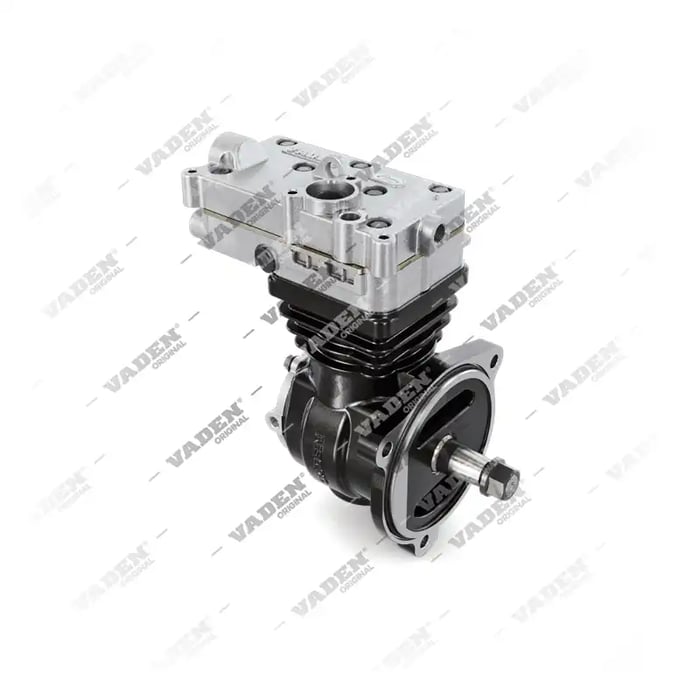
Need the part, not just the answer?
OE-grade air brake compressors and repair kits, manufactured and tested to commercial-vehicle standards.
Shop VADEN partsPublished by VADEN Original. Product links point to the manufacturer’s official catalogue. Specifications are general — always confirm figures against your vehicle’s service manual.