 airbrakecompressor
If a truck will not build air and the governor is stuck in its cut-out position, the governor keeps feeding air to the compressor's unloader, the intake valves stay held open, and the compressor spins without pumping anything into the tanks. The fastest way to prove it: with reservoir pressure below the cut-in point of roughly 100-110 psi, there should be no air at the compressor's unloader port. Air sitting there means the governor or its plumbing is the fault. No air there, and you move on to the compressor's own unloader, the discharge line, the air dryer, or a leak. Everything below is that test, expanded, plus what actually sticks a governor and how to keep the replacement alive.
What "cut in" means and why a stuck governor kills air production
The air governor is a pressure-sensing pilot valve, not a brake control. It reads supply (wet tank) pressure through a small line and decides one thing: whether the compressor loads or unloads. Below cut-in, typically 100-110 psi, the governor vents the unloader line to atmosphere through its exhaust port, the compressor's unloader mechanism releases, and the compressor pumps. When pressure reaches cut-out, generally 120-135 psi depending on the OEM setting, the governor connects reservoir air to the unloader line and the compressor runs unloaded. A healthy system idles around 120 psi fully charged, and the differential between cut-in and cut-out is built into the governor on most designs, not separately adjustable.
A governor stuck in the cut-out state never releases that unload signal. The compressor turns, the crank makes noise, oil circulates, but no usable air reaches the tanks. Pressure bleeds down through normal system leakage, the low-air warning light and buzzer come on around 60 psi, and if it keeps falling the spring brakes apply somewhere in the 20-45 psi range and park the truck where it sits. Note the mirror-image fault: a governor stuck in cut-in, or fed by a plugged supply line, makes the compressor run constantly and never cut out. Different symptom, different cause.
Isolate it: governor, unloader, or compressor
Chock the wheels before you start. As pressure drops the spring brakes will set, and when you build pressure back up they release. The discharge line and compressor head run hot enough to burn. Drain tanks slowly and wear eye protection.
- Chock the wheels, set the parking brakes, and drain the reservoirs so both dash gauges read well below cut-in.
- Start the engine and hold a fast idle for a minute while you watch the gauges. A sound system climbs steadily; a common shop benchmark is building from about 85 to 100 psi in well under a minute at fast idle, but confirm the figure in the OEM service data for that chassis.
- With pressure still below cut-in, crack the unloader signal line at the compressor head. Any air escaping there is the governor telling the compressor to stop pumping when it should be loading.
- Cap that port at the compressor and run the engine again. If the compressor now builds pressure normally, the governor or its line is confirmed as the fault.
- If there was no air at the unloader port and the compressor still will not build, the problem is downstream: a compressor unloader held open by carbon or a broken spring, damaged discharge valves, a carboned discharge line, a dryer purging continuously, or a leak larger than the compressor's output.
- Listen at the governor exhaust port through a full cycle. Continuous leakage there means internal seals are gone.
- Blow through the governor supply line. A plugged or ice-blocked supply line makes the governor read artificially low and stops it cutting out at all.
Reading the results
| What you find | What it points to | Next move |
|---|---|---|
| Air at the compressor unloader port with tanks below cut-in | Governor stuck in the unload position, or the signal line landed on the wrong port after a repair | Cap the port and retest; if it builds, rebuild or replace the governor |
| No air at the unloader port, still no build | Unloader plungers or piston stuck open, broken discharge valves, blocked discharge line | Inspect the unloader assembly and check the discharge line for carbon |
| Continuous air from the governor exhaust port | Internal leak past the piston seal or valve assembly | Replace the governor; a leaking exhaust also masks the unload signal |
| Dryer purge valve venting nonstop | Dryer dumping everything the compressor makes | Service the purge valve and desiccant cartridge before condemning anything else |
| Builds to 60-80 psi then stalls | Leak rate exceeding compressor output, or a worn compressor | Run an applied and released leakage test, then a compressor output check |
| Never cuts out, pumps past normal pressure | Plugged governor supply line or governor stuck in cut-in | Opposite fault; clear the supply line and verify the safety valve |
Why governors stick
- Contamination. Oil carryover from a tired compressor, water, and carbon sludge coat the piston bore and gum the inlet and exhaust valve assembly. This is the number one cause by a wide margin.
- Ice. Moisture that made it past a saturated dryer freezes in the governor body or its supply line overnight and thaws by mid-morning, which is why the fault often looks intermittent in winter.
- Corroded or scored piston bore. Once the bore is pitted, the piston hangs up regardless of how clean the air is afterward.
- Weak, broken, or badly adjusted pressure spring. Someone chasing a pressure complaint with the adjusting screw can push the settings far enough that the unit behaves as if it is stuck.
- Plugged exhaust port. If the unloader line cannot vent, the compressor stays unloaded even when the governor piston moves correctly.
Repair, replace, and reset
Some governors accept a rebuild kit, but on a unit that stuck because of oil and carbon, replacement is usually the honest call, and the labor is nearly identical either way. Replace the unloader signal line if it is oil-soaked or full of scale, because that debris will migrate straight into the new valve. Fit the correct part for the compressor and chassis, not just one that threads in: settings and port arrangements vary between OE families such as Bendix, Wabco/ZF, Knorr-Bremse and Haldex. If you are sourcing parts, OE-grade compressor governor valves cross-referenced by OE number take the guesswork out of matching the unit already on the engine.
After fitting, verify with a calibrated test gauge at the supply reservoir rather than trusting the dash gauge, and watch two or three complete cycles. Cut-out should land where the OEM specifies within the 120-135 psi band, cut-in should follow at roughly 100-110 psi, and the exhaust port should be dry and silent between cycles. If you adjust, move the screw in small increments and recheck each time. Never set cut-out anywhere near the tank safety relief valve, which is commonly set around 150 psi.
Stop it coming back
A governor that sticks once will stick again if the air stays dirty. Drain the tanks daily or confirm the automatic drains work, service the air dryer cartridge on the OEM interval, and check whether the compressor is passing oil, since oil in the governor is a symptom rather than the disease. If the truck was already struggling to build pressure before the governor failed, fix the compressor and dryer at the same time. Otherwise the new governor becomes the next thing you replace.
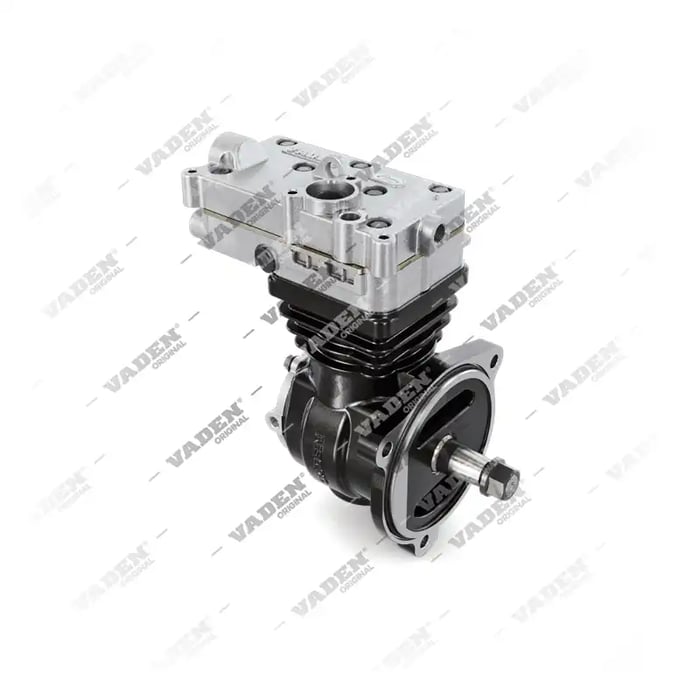
Need the part, not just the answer?
OE-grade air brake compressors and repair kits, manufactured and tested to commercial-vehicle standards.
Shop VADEN partsPublished by VADEN Original. Product links point to the manufacturer’s official catalogue. Specifications are general — always confirm figures against your vehicle’s service manual.