 airbrakecompressor
Yes — on nearly every air-ride truck, tractor, coach, or air-suspended trailer, the air suspension and the air brakes are fed by the same engine-driven compressor and the same wet tank. They are not the same system, though. Accessory air is tapped downstream of the air dryer through a pressure protection valve that closes when supply pressure sags, so the brake reservoirs keep the air and the suspension goes without. That one valve is the reason a blown air bag normally leaves you with working brakes — and the reason a failed valve turns a suspension leak into a safety problem.
Where the air splits
The layout is broadly the same whether you are looking at a North American tractor or a European chassis:
- Compressor — gear- or belt-driven off the engine, pumping continuously and loading only when the governor tells it to.
- Discharge line and air dryer — the dryer strips water and oil mist and purges every time the governor unloads the compressor.
- Wet tank (supply reservoir) — the common pool. Everything on the vehicle that uses air draws from here.
- One-way check valves feed the primary and secondary service reservoirs. Brakes are charged first, and each circuit is isolated from a failure in the other.
- Accessory feed — suspension, cab air, air seat, PTO, horn, fifth-wheel slider, and on a bus the kneel and door systems — comes off the wet tank or a dedicated accessory tank through a pressure protection valve.
So the shared part is the supply side: compressor, dryer, governor, wet tank. The moment air leaves that pool, brakes and suspension are on separate branches with different priorities.
Why the brakes get priority
This is not a design courtesy — it is regulated. FMVSS 121 in the United States and ECE R13 in Europe both require that a failure in a non-braking auxiliary circuit cannot drain the braking circuits below what is needed to stop the vehicle. Manufacturers satisfy that with check valves protecting each service reservoir and a pressure protection valve on every accessory tap.
A pressure protection valve is simply a spring-loaded, pressure-sensitive shutoff. Below its opening setting it stays closed and passes nothing; above that setting it opens and lets the accessory circuit fill. If the suspension side develops a leak and drags system pressure down toward the valve's closing point, the valve shuts and the leak stops taking air from the brakes. Opening settings vary by manufacturer and application and are commonly somewhere in the 65-90 psi band — always confirm against the OE spec stamped on the valve or listed in the chassis service literature rather than assuming a figure.
Typical pressures across the shared system
| Point in the system | Typical range | Notes |
|---|---|---|
| Governor cut-out (compressor unloads) | 120-135 psi | Top of the normal operating band |
| Governor cut-in (compressor loads) | 100-110 psi | Roughly 20-25 psi below cut-out |
| Fully charged system, running | about 120 psi | Both gauges should sit close together |
| Low-air warning light and buzzer | about 60 psi | Must activate at or above this level |
| Spring brakes begin to apply | 20-45 psi | Parking and emergency brakes set themselves |
| Accessory pressure protection valve opens | manufacturer-specified, commonly 65-90 psi | Verify against OE data, do not assume |
| Air bag working pressure | varies with load | Set by the leveling valve, well below supply pressure |
What the suspension side does with the air
The suspension does not hold a fixed pressure. A height control (leveling) valve senses ride height through a linkage arm and meters air into the bags as load goes on, exhausting it as load comes off. Add a pallet and the valve fills; unload and it dumps. Many chassis also have a manual dump valve, and buses add a kneel function that vents one side quickly.
The practical consequence: the suspension is a consumer that cycles all day long, and every fill event is air the compressor has to make. A loading dock cycle that dumps and refills the bags repeatedly puts real duty on the compressor even with the truck standing still.
Faults that cross between the two systems
Compressor runs constantly or cycles too often
Before condemning the compressor, account for accessory demand. A leaking air bag, a worn leveling valve that weeps at the exhaust port, or a dump valve that will not seat can keep the compressor loading every couple of minutes. The tell is that the leak is downstream of the protection valve: system pressure never falls far enough to trip low-air warning, but the compressor never gets a rest either.
Slow build, or pressure that will not climb past a point
If the accessory circuit is bleeding faster than the compressor can make air, build time suffers everywhere. Shut the suspension supply off — or close the accessory feed if the chassis has a service cock — and re-run the build test. If build time normalizes, the suspension side owns the fault, not the compressor.
Brake pressure dropping with a suspension leak
This should not happen. If a suspension leak pulls the brake gauges down toward the warning level, the pressure protection valve is stuck open or a check valve has failed, and the vehicle no longer meets its designed failure protection. Treat it as an out-of-service condition and fix the valve, not just the bag. The general procedure for tracing this is the same one used for any case of the air brake system losing pressure.
Oil and moisture reaching everything
Because supply is shared, contamination is shared. A compressor passing oil, or a saturated desiccant cartridge, sends oil mist and water into the suspension bags, the leveling valve, and the dash valves along with the brake circuits. Oil swells rubber seals and diaphragms; water freezes in winter and locks a leveling valve or a dump valve solid. Water in the tanks is a supply-side problem with vehicle-wide consequences.
Isolating the fault
Work from the shared supply outward:
- Charge the system to governor cut-out, shut the engine down, chock the wheels, and note the leak-down rate with brakes released, then again with the service brakes applied and held.
- Close or cap the accessory feed and repeat. A large improvement points at suspension, cab, or seat air.
- Soap the bags, the leveling valve ports, the dump valve, and every push-to-connect fitting on the accessory branch. Air suspension leaks are usually at fittings and valve exhausts, not in the bag itself.
- Verify the protection valve actually closes: bleed the accessory circuit and confirm the brake gauges stabilize instead of continuing down.
If a suspension leak can drag the brake gauges toward the low-air warning point, the fault is no longer a suspension fault. Fix the protection valve before the vehicle goes back to work.
Maintenance that protects both circuits
Everything upstream of the split is maintenance that pays twice. Drain the wet tank on a schedule (or verify the automatic drain works), replace the dryer desiccant cartridge at the interval the OE specifies, keep the governor cut-in and cut-out inside their bands, and address a compressor that passes oil promptly rather than letting it coat the whole system. Keeping the compressor, governor, and dryer healthy is the single best way to protect both circuits, and VADEN supplies OE-grade air processing units for that supply side of the system.
Bottom line: shared supply, separate priorities. Understand where the split happens and which valve enforces it, and most brake-versus-suspension complaints sort themselves out in the first ten minutes of diagnosis.
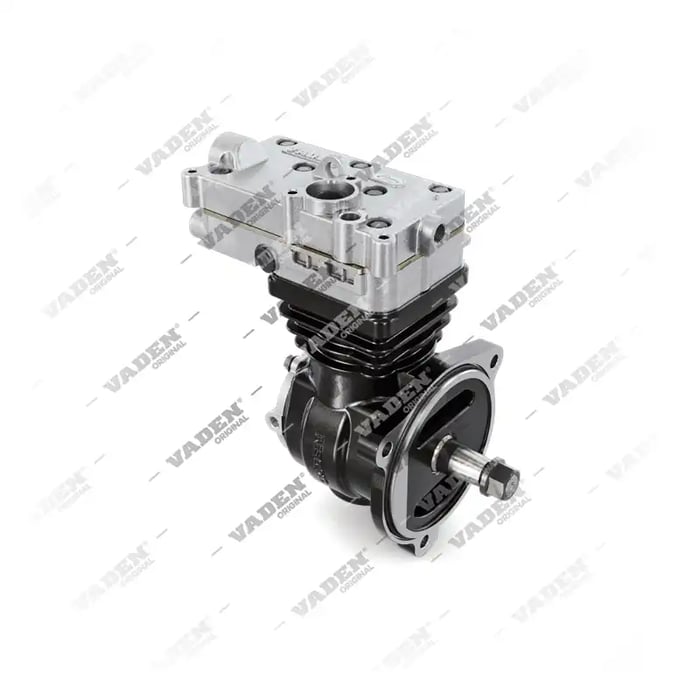
Need the part, not just the answer?
OE-grade air brake compressors and repair kits, manufactured and tested to commercial-vehicle standards.
Shop VADEN partsPublished by VADEN Original. Product links point to the manufacturer’s official catalogue. Specifications are general — always confirm figures against your vehicle’s service manual.