 airbrakecompressor
Garbage truck air brakes use the same pneumatic hardware as any other heavy chassis: compressor, governor, air dryer, reservoirs, treadle valve, relay valves, brake chambers and S-cam foundation brakes. What is different is the duty cycle. A residential route truck stops, sets, releases and pulls away hundreds of times in a shift, at low speed and near full weight, while the body draws air of its own, and that workload consumes chambers, linings, drums and compressors on a timeline no odometer-based PM schedule will ever catch.
Why refuse duty is harder than highway miles
Air brakes are pneumatic. Compressed air is stored in the reservoirs, and pressing the treadle meters that air into the brake chambers, which stroke the pushrods, turn the slack adjusters and rotate the S-cams into the drums. Every application spends air the compressor has to make back. A linehaul tractor might make a handful of service applications in a mile; a packer truck on a collection route makes one every few seconds of forward motion, then sets the parking brake, then releases it, all day.
Accessory air is the load nobody counts
Most refuse bodies pull from the same supply as the brakes: tailgate locks, packer and hopper controls, PTO engagement, air seats, and levelling valves that keep the chassis sitting straight as the body fills. Stack that on top of service braking and the compressor's loaded time climbs far above the roughly 25 percent target chassis engineers design toward. High loaded time means high discharge temperature, and high discharge temperature is exactly what bakes oil into carbon inside the discharge line and starts pushing oil past the rings. If you are sizing or diagnosing a unit on this kind of chassis, start with compressor duty cycle and accessory air demand rather than engine displacement.
Track hours and stops, not the odometer
A route truck can run a full shift and put almost nothing on the odometer. Service it on mileage and it will get roughly half the brake attention it needs. Build the schedule on engine hours, PTO hours or route stops, and the intervals below start making sense.
What fails first on a refuse chassis
Brake chambers and pushrod stroke
Diaphragms fail from flex cycles, not from age alone, and a route truck accumulates cycles at a rate a highway truck never approaches. Clevis pins, pushrod yokes and return springs wear on the same clock. The trap is the automatic slack adjuster: it senses excess clearance during a full application, and a route driver makes thousands of light, short applications that may never develop enough stroke to trigger take-up. Adjustment drifts out even though the slack adjusters are working exactly as designed. Measure applied stroke at every PM with the system between 90 and 100 psi and the engine off, compare it to the marked limit for the chamber size, and treat any side-to-side mismatch as a fault. If you find one out, follow the correct slack adjuster procedure and then look for the cam bushing or chamber that let it drift.
Linings, drums and heat
Each individual stop is low-energy, but the drums never get a chance to shed heat between them. The result is glazed linings, heat-checked and out-of-round drums, and hard spots that show up later as a shudder. Anything that keeps a brake lightly applied after release, such as a sticking relay valve or a tired chamber return spring, adds heat continuously and will cook a wheel end on a route long before it would on the highway.
Compressor, air dryer and tanks
More pumping means more moisture and more oil vapour arriving at the dryer. A desiccant cartridge specified for highway service saturates early in refuse work, and once it does, water and oil go straight into the reservoirs and onward into the valves. Oil at the purge, a milky drain, or valves that release slowly all point back to the same cause. Landfill and transfer-station dust adds the second half of the problem: an unfiltered or poorly routed compressor intake ingests abrasive dust, wears the rings, and the truck starts passing oil.
Severe-duty PM intervals for refuse trucks
| Check | Typical highway practice | Refuse severe-duty practice | What you are looking for |
|---|---|---|---|
| Drain reservoirs | Weekly or at PM | Daily, end of shift; verify automatic drains actually cycle | Water, and any oil beyond a light film |
| Applied pushrod stroke | Each PM | Each PM and any time wheels are off | Stroke past the chamber limit; uneven left to right |
| Air dryer cartridge | Per OEM, often annually | Roughly half the highway interval, set on hours | Saturated desiccant, oil carryover, purge that will not stop |
| Compressor discharge line | At overhaul | Inspect on an hour-based cycle | Carbon restriction, which raises both pressure and temperature |
| Compressor intake source | With engine PM | Every PM in dusty operation | Dirt ingestion, collapsed hose, unfiltered supply |
| Governor operation | Each PM | Each PM | Cut-out 120-135 psi, cut-in 100-110 psi, clean unload every cycle |
| Leakage test | Pre-trip and PM | Daily pre-trip, applied and released | Drop within the limit for the configuration; a straight truck is held tighter than a combination |
| Linings, drums, S-cam bushings | Mileage-based | Hour-based and shortened | Glaze, heat checking, cam play that lets stroke wander |
Symptoms that should pull a route truck out of service
- Low-air warning coming on mid-route as pressure falls toward about 60 psi, meaning demand has outrun supply.
- A compressor that runs loaded almost constantly and struggles to reach a normal fully charged pressure near 120 psi.
- Oil at the dryer purge or in the drained tank water.
- Brakes that release slowly, or spring brakes dragging on as pressure sags into the 20-45 psi band.
- A wheel end noticeably hotter than the others after a normal collection leg.
Replacing parts without repeating the failure
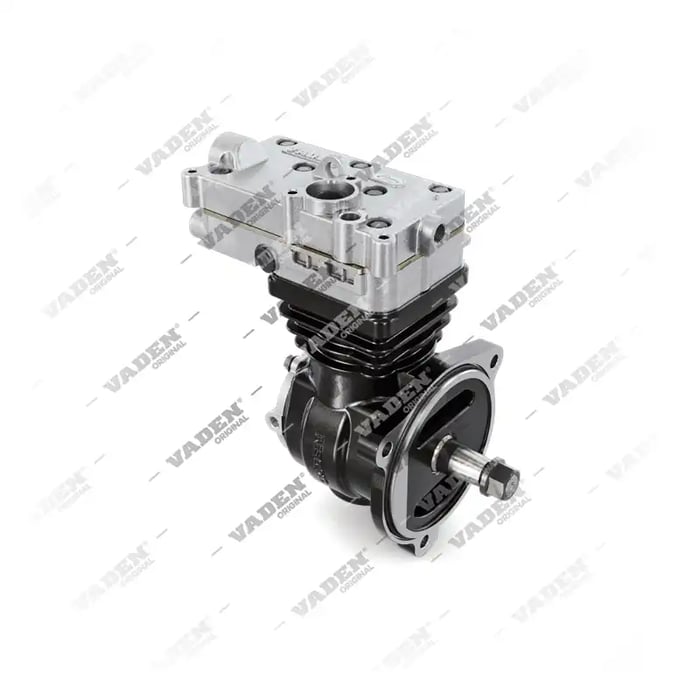
When the compressor is the casualty on a refuse chassis, hanging a new one on without addressing the cause simply schedules the next failure. Flush the system, replace the dryer cartridge, and clear or replace a carboned discharge line before the truck goes back on route. Specify a unit whose displacement suits the combined brake and body air demand rather than the engine alone, and cross-reference against the OE part the chassis was built with, whether that is a Bendix, Wabco, Knorr-Bremse or truck-maker number. OE-grade replacements such as these heavy-duty air brake compressors are worth specifying on a chassis that will never see an easy duty cycle. From there, treat the whole system as a severe-duty asset and hold to a shortened compressor maintenance routine.
A second compressor failure on the same truck is almost never a defective compressor. It is a restricted discharge line, a saturated dryer, or an air demand the unit was never sized to meet.
Need the part, not just the answer?
OE-grade air brake compressors and repair kits, manufactured and tested to commercial-vehicle standards.
Shop VADEN partsPublished by VADEN Original. Product links point to the manufacturer’s official catalogue. Specifications are general — always confirm figures against your vehicle’s service manual.