 airbrakecompressor
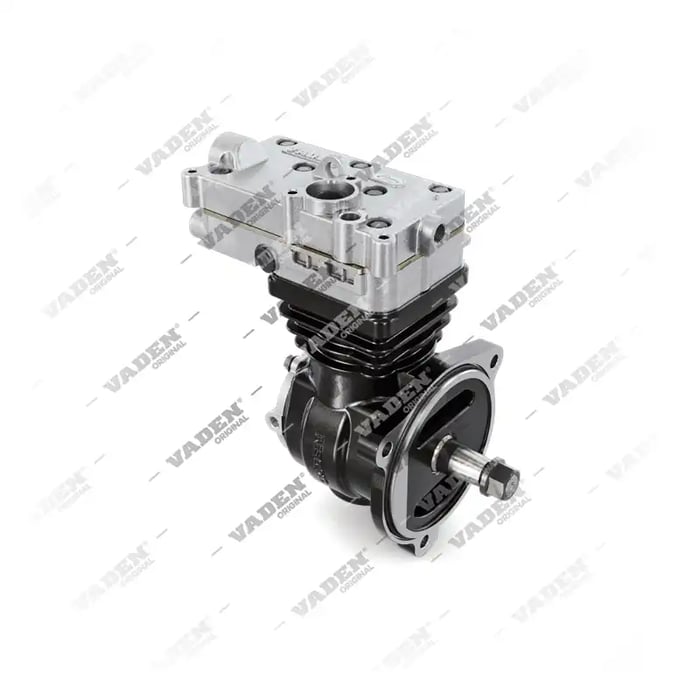
The Bendix Tu-Flo is a family of engine-driven reciprocating (piston) air compressors that charge the pneumatic system feeding a truck's air brakes. The range spans the single-cylinder Tu-Flo 501 and the twin-cylinder 550, 700, and 750, with swept volume and airflow climbing as the model numbers rise. Because every member shares the same basic architecture—a cylinder head, inlet and discharge valves, engine-oil lubrication, and a governor-controlled unloader—most service procedures and many wear parts carry across the whole line.
Tu-Flo family at a glance
All four are gear- or belt-driven off the engine, pressure-lubricated from the engine's oil supply, and on most versions cooled by engine coolant routed through the head. What changes across the range is cylinder count and displacement.
| Model | Cylinders | Relative displacement | Typical application |
|---|---|---|---|
| Tu-Flo 501 | Single | Smallest | Light and medium-duty, lower air demand |
| Tu-Flo 550 | Twin | Moderate | Medium-duty highway trucks |
| Tu-Flo 700 | Twin | Large | Heavy-duty on-highway |
| Tu-Flo 750 | Twin | Largest | Heavy-duty with high air demand |
Displacement and output
The single-cylinder 501 pumps on one piston, while the 550, 700, and 750 use two cylinders and therefore move considerably more air per revolution. Actual output is a function of compressor speed: airflow rises with engine rpm, so a 750 turning fast delivers well into the teens of CFM, and the same unit at idle produces far less. Bendix builds both naturally aspirated versions, which draw through their own inlet filter, and versions plumbed to the engine's boosted intake, where the incoming charge is already above atmospheric pressure and output climbs accordingly. Treat displacement and CFM as ballpark until you confirm them against the Bendix spec sheet for the exact part number—two compressors with the same family name can be rated differently.
Port layout and drive options
A Tu-Flo head carries several ports, and their position and thread size vary between spec numbers. Expect:
- A discharge port feeding the air dryer or wet tank.
- An inlet port, fed either from the compressor's own air filter or from the engine intake.
- An unloader/governor signal port that receives control air from the governor.
- Coolant ports for the water-cooled head, plus oil feed and drain passages.
Drive and mounting are where the family fragments most. Units come flange-mounted or base-mounted, gear-driven off the timing gears or driven through a spline, and in single-drive or through-drive form—the latter passing torque out the back to run an accessory such as a power steering pump. None of that is optional to match: the mount, drive, and cooling type must line up with what the engine expects.
Unloader arrangement
A Tu-Flo does not stop and start; it turns whenever the engine turns and is switched between pumping and idling by the governor. When system pressure reaches the governor cut-out point—typically 120 to 135 psi—control air is sent to the compressor's unloader pistons, which lift the inlet valves off their seats so the compressor spins freely without compressing. When pressure falls to the cut-in point, usually 100 to 110 psi, the governor vents that signal, the inlet valves reseat, and the compressor loads again. A fully charged system sits around 120 psi, and the dash low-air warning should sound near 60 psi. If the unloaders stick or the governor signal is wrong, the compressor either never unloads or never loads—review how the unloader circuit works when diagnosing a unit that runs constantly or will not build.
Wear items and common failures
Because the family shares a design, it shares failure modes. The parts that wear or need resealing are:
- Cylinder head gasket—coolant or air leaks and cross-porting between chambers.
- Inlet and discharge valves—leaking valves cut output and let air blow back.
- Unloader kit—pistons, springs, and seals that keep the head from unloading cleanly.
- Piston rings—worn rings let oil past into the discharge, the classic oil-pumping complaint.
- Bearings and discharge line—carbon buildup in the discharge line raises head temperature and back-pressure, which accelerates every other failure.
Interchange within the range
Sharing a family name does not make two Tu-Flo compressors drop-in equivalents. Before you swap, the mounting style, drive type, port orientation, cooling method, and intake source all have to match the outgoing unit. The safest path is to read the nameplate or casting number and cross-reference it rather than trusting the model number alone—decoding the part number tells you which specific build you have. When the replacement matches on mount, drive, cooling, and ports, moving up or down within the range to gain or shed displacement is straightforward; when any of those differ, it is effectively a different compressor even if the badge reads the same.
Rebuild or replace
A Tu-Flo that is passing oil or failing to build usually responds to a valve-and-unloader reseal if the bore and bearings are still in spec. Once the cylinder is scored or the crankshaft has play, a reman or new unit is the better value. Either way, replace the discharge line and service the air dryer at the same time, or leftover carbon and moisture will shorten the life of the fresh compressor.
Need the part, not just the answer?
OE-grade air brake compressors and repair kits, manufactured and tested to commercial-vehicle standards.
Shop VADEN partsPublished by VADEN Original. Product links point to the manufacturer’s official catalogue. Specifications are general — always confirm figures against your vehicle’s service manual.