 airbrakecompressor
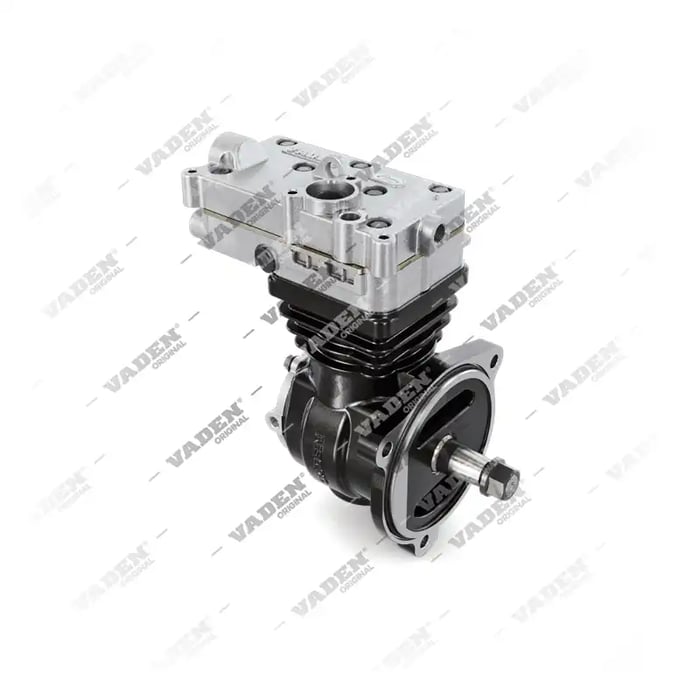
The Bendix BA-921 is a single-cylinder, reciprocating air brake compressor and one of the highest-volume models Bendix has built for heavy trucks, buses, and vocational equipment. It draws intake air, pumps it under pressure into the wet tank, and cycles between loaded and unloaded states under governor control to hold the system fully charged at roughly 120 psi. Its signature feature is the ESP (Extended Service Protection) unloader design, built to cut oil carryover and carbon buildup in the discharge line — the failure that ends most air compressors.
BA-921 specifications at a glance
The BA-921 is a moderate-displacement single-cylinder unit: enough output for most single-drive tractors, straight trucks, and coaches without the duty cycle of a large twin. Exact ratings vary by casting, cooling, and drive type, so always confirm against the part number stamped on the housing.
| Attribute | Bendix BA-921 |
|---|---|
| Type | Single-cylinder, reciprocating, pneumatic (air brake supply) |
| Displacement | Roughly 13-14 CFM at governed engine speed |
| Unloading | ESP (Extended Service Protection) integral unloader |
| Cooling | Air-cooled or coolant-cooled head, depending on variant |
| Lubrication | Pressure-fed from the engine oil gallery |
| Drive | Gear-driven or belt/pulley-driven, variant dependent |
| Mounting | Flange or pad mount, multiple bolt patterns and port layouts |
| Working pressure | Governor-controlled: cut-out ~120-135 psi, cut-in ~100-110 psi |
How the BA-921 loads and unloads
Like every truck air compressor, the BA-921 runs continuously whenever the engine turns, but it only pumps air part of the time. The air governor senses reservoir pressure and switches the compressor between two states. When pressure reaches cut-out (about 120-135 psi), the governor sends an air signal to the compressor's unloader, which holds the intake valves open so the piston moves air back and forth without building pressure — the "unloaded" state. When pressure falls to cut-in (about 100-110 psi), the governor exhausts that signal, the unloader closes, and the compressor loads and pumps again. If the low-air warning ever sounds near 60 psi, the compressor and governor should be your first stop. See how the air governor controls cut-in and cut-out for the full loop.
The ESP part of the BA-921 name refers to Bendix's Extended Service Protection unloader and inlet design. During the unloaded phase, ordinary compressors can draw crankcase oil past the rings and up through the discharge line, where it bakes into carbon. ESP reworks the intake and unloader path to reduce that oil carryover and lower discharge temperatures, which slows carbon buildup downstream in the discharge line and air dryer. A healthy unloader valve is central to both pressure control and long compressor life.
Mounting and drive configurations
Part of why the BA-921 is so common is that Bendix offers it in many mounting and drive variants to fit different engines. You will find gear-driven versions that bolt to the engine timing case and belt/pulley-driven versions on an accessory bracket, plus flange-mount and pad-mount flanges with different bolt circles, port sizes, and coolant fittings. Two BA-921 compressors can share the model name yet be physically different castings. Before ordering, record the full Bendix part number, count the mounting holes, note the bolt pattern, and confirm the intake, discharge, and coolant port locations so the replacement drops in without adapters.
Common BA-921 failures
Oil pumping and discharge-line carbon
The classic BA-921 complaint is oil at the discharge port and oil-fouled desiccant in the air dryer. Some oil misting is normal; a slug of oil in the tanks or a purge valve that spits oil is not. Worn piston rings, a clogged discharge line, or a compressor forced to run loaded far too often (a leaking system that never lets it unload) all drive oil into the brake system. If you find oil downstream, read why an air compressor pumps oil and fix the root cause — replacing the compressor without decontaminating the lines and dryer just re-fouls the new unit.
Knocking, leaks, and low output
A BA-921 that knocks under load usually has worn bearings, a failing connecting rod, or a loose drive gear. Air leaking continuously from the governor's unloader port often points to a stuck-open unloader or worn intake valves. If the compressor cannot bring the system up to cut-out or takes far too long, suspect leaking discharge/intake valves, a restricted air filter, carbon in the discharge line, or — just as often — leaks elsewhere in the brake system rather than the compressor itself. Always rule out system leakage before condemning the pump.
Rebuild or replace a BA-921?
Because the BA-921 is a single-cylinder unit, rebuild kits (unloader, gasket, and valve kits; some full ring-and-bearing kits) are widely available and cost-effective for a compressor with a good bore and crank. If the block is scored, the crank is worn, or the unit has already been apart once, a new or remanufactured compressor is usually the better value and comes with a fresh warranty. Whichever route you take, replace or thoroughly clean the discharge line and service the air dryer at the same time so old carbon and oil do not migrate into the new parts.
Buying and cross-referencing
The BA-921 competes in the same duty class as Bendix's twin-cylinder Tu-Flo family; if you are weighing single versus twin output for a heavier duty cycle, compare it against the Bendix Tu-Flo 550/750 compressors. When sourcing a replacement, match by engine application and the exact Bendix part number, then verify the mounting flange and ports physically. OE-grade replacements and repair kits cross-reference to the original Bendix numbers, so you can fit a compatible unit without changing brackets, drives, or plumbing.
Need the part, not just the answer?
OE-grade air brake compressors and repair kits, manufactured and tested to commercial-vehicle standards.
Shop VADEN partsPublished by VADEN Original. Product links point to the manufacturer’s official catalogue. Specifications are general — always confirm figures against your vehicle’s service manual.